One campaign for everything
Termites, rodents, mosquitoes and recurring plans share one budget and one message, so nobody can tell what works.
When a homeowner searches for a termite inspection or help with rodents, the need is immediate. Google Ads lets you appear at exactly that moment, but only if the campaign is built around the economics of each job, the real search terms customers use and a landing page that makes it easy to call. We build pest-control campaigns for companies across the United States, targeting qualified calls in the specific areas they actually serve, not just clicks.
Free review of your website, Google visibility and lead path. No obligation.

Pest-control searches carry strong intent. People search when they have a problem, and many want help the same day. That makes paid search one of the fastest ways to reach customers who are ready to act.
The same intent attracts waste. Irrelevant clicks from job seekers, do-it-yourself searchers, wrong locations and unrelated services can drain a budget quickly. The difference between a profitable account and a costly one is structure, search-term discipline and what happens after the click.

Most wasted spend comes from a handful of structural problems.
Termites, rodents, mosquitoes and recurring plans share one budget and one message, so nobody can tell what works.
Clicks from jobs, salaries, DIY products and courses burn budget.
The visitor lands on a generic page instead of the service they searched for.
Budget flows to areas your crews do not serve or cannot reach profitably.
Many calls are vendors, wrong services or outside the area, and nobody classifies them.
The account optimizes for clicks because nobody told it what a good lead is.
Good leads cool before anyone calls back.
Spend ignores the seasons when termite or mosquito demand moves.
Six steps, from structure to ongoing optimization.
We start with which services earn the most, which are recurring, where your crews can go and what capacity you have. Campaign priorities follow the economics of the job.
Services get separate campaigns, with ad groups for the specific intent inside each, so budget and results are visible by service rather than blended.
We choose keywords for each intent, then review the real search terms that trigger your ads and use them to refine targeting and negatives.
Ads follow a clear path: problem, service, location, trust, call to action. We avoid misleading urgency and make claims you can stand behind.
Each campaign goes to a page that matches the search, with a visible phone number, short form and tracking for calls and forms.
We review spend, search terms, locations, devices, ads and lead quality on a regular schedule, and adjust budgets toward what produces qualified enquiries.
The pieces of a well-run pest-control account.
Service-specific campaigns and ad groups built around real intent.
Clear, honest ad copy with call, location and service extensions.
A list built from real search-term data, kept current as queries change.
Targeting that matches your routes, with exclusions for areas you do not serve.
Conversion tracking so the account learns from real enquiries.
Plain-English reports and regular improvements tied to lead quality.
Each service gets its own path from search to enquiry. This is an example, not the only valid structure.
| Campaign | Ad groups | Landing page | Conversion |
|---|---|---|---|
| Termites | Inspection, treatment, signs of termites | Termite service page | Call or form |
| Recurring pest control | Quarterly service, general protection | Recurring plan page | Call or form |
| Rodents | Rodent control, rodent exclusion | Rodent service page | Call or form |
| Mosquitoes | Mosquito control, seasonal plans | Mosquito service page | Call or form |
| Commercial | Restaurants, property managers | Commercial page | Quote request |
Reviewing real search terms is one of the most important ongoing activities in any paid-search account.
What you tell Google you are interested in. Match types control how closely a search must relate to it.
What the customer actually typed. These are the queries that triggered your ads and cost you money.
Terms you block so you stop paying for irrelevant searches. The list always comes from real data.
Typical irrelevant intent includes pest control jobs, pest control salary, DIY pesticide, pest-control certification, free pest-control courses, pest-control wholesale and insect identification only. We review search terms regularly, add negatives from real data and take care not to block valuable terms by accident.
Everything should feel continuous from the search to the enquiry.
The landing page repeats the promise of the ad, shows the phone number clearly on mobile, keeps the form short, adds trust proof and answers common questions. We do not use urgency that is not genuinely true.
A campaign can generate many calls and still perform badly if the calls are:
We connect optimization to lead quality by classifying calls and feeding the result back into keywords, ads, locations and budgets.
We do not recommend arbitrary daily budgets without account data. We consider:
We report qualified outcomes, not just clicks and impressions.
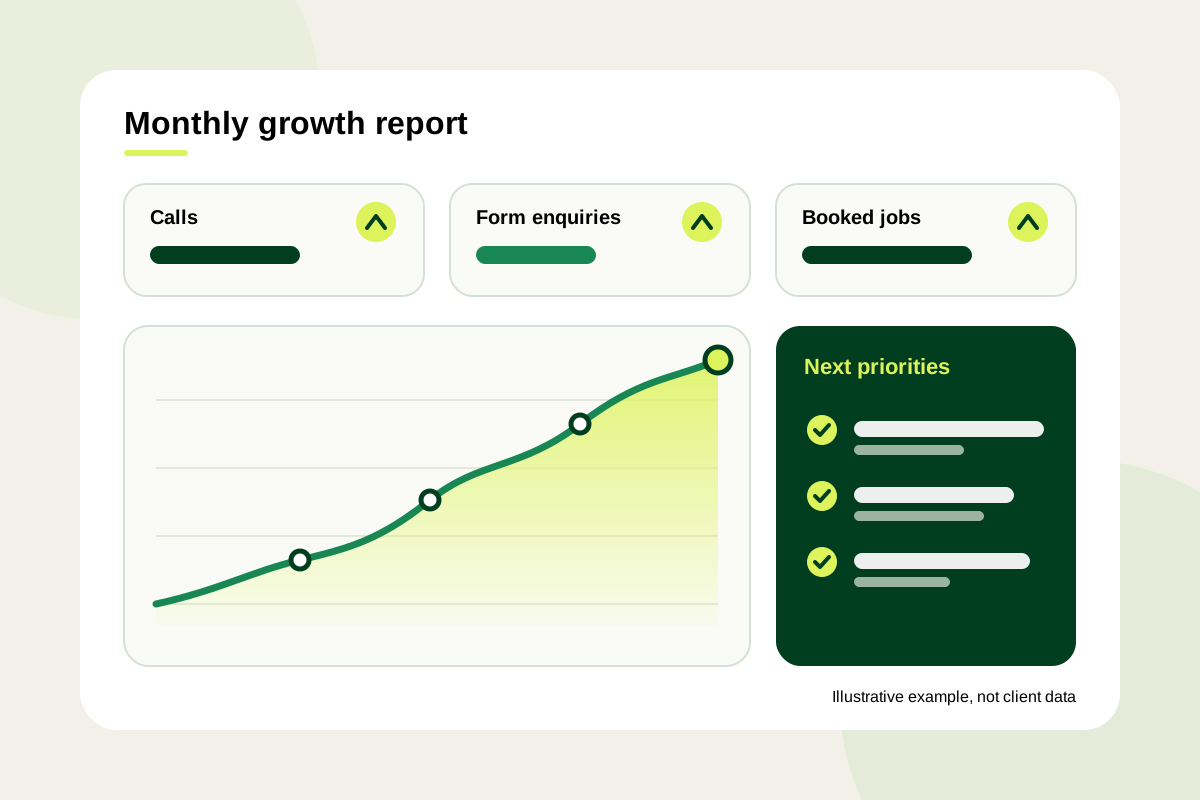
We do not publish Google Ads screenshots or figures we cannot attribute to a named client. What we can show is the reporting structure: spend, qualified calls and forms, search terms, locations and landing-page results, reviewed with you on a regular schedule.
The illustration shows the kind of report you receive. Your numbers come from your own account and your own call data.
Depending on engagement scope, this is what you can expect.
Paid search is a poor first investment if you cannot answer calls quickly, have no capacity for more work or have a website that does not give visitors a clear way to contact you. Fixing those first usually pays back faster.
Setup from $300; ad spend separate
Final scope is based on your service mix, local competition, current website condition and required integrations. Paid media budgets are always separate from our fees.
Get Your Free Pest Control Marketing Audit See all starting points
It depends on your market, services, competition and capacity. We do not suggest a budget without looking at your account data and economics. A small, well-structured test often teaches more than a large unfocused one.
No. Ad spend is paid directly to Google and is always separate from our setup and management fees.
A keyword is what you tell Google you want to target. A search term is what the customer actually typed. Reviewing search terms is how we find wasted spend and new opportunities.
Termites, rodents, mosquitoes and recurring plans have different value, urgency and competition. Separate campaigns let you see what each produces and put budget where it works.
We reduce them with negative keywords built from real search-term data, though some irrelevant clicks always occur. We review and update the list regularly.
With conversion tracking for tap-to-call clicks and, where set up, call tracking that records the source, campaign and outcome. We classify calls so you can see which ones were genuinely qualified.
Ads can start generating enquiries soon after launch, but the first weeks are also for learning which searches and messages work. We optimize continuously and never promise a specific number of leads.
If you need enquiries soon and can handle them, ads can provide faster demand. SEO builds visibility that lasts. They work well together, and the audit shows which should come first for you.
Request a practical review of your website, search visibility and enquiry journey. We will identify relevant opportunities and explain the next steps before recommending paid work.
No obligation. No spam. Clear recommendations for your business.
We will review your website, Google Maps visibility and lead-conversion path, then send you three practical opportunities to generate more qualified pest-control enquiries.
No obligation. No spam. Clear recommendations for your business.