Google Local Services Ads for Pest Control: Are They Worth It?
Local Services Ads for pest control can be worth testing when your company qualifies, answers calls consistently, and can turn inquiries into profitable jobs. Paying for a lead is not the same as booking an inspection. Your decision should reflect service areas, technician capacity, lead quality, and the contribution you earn from completed work.

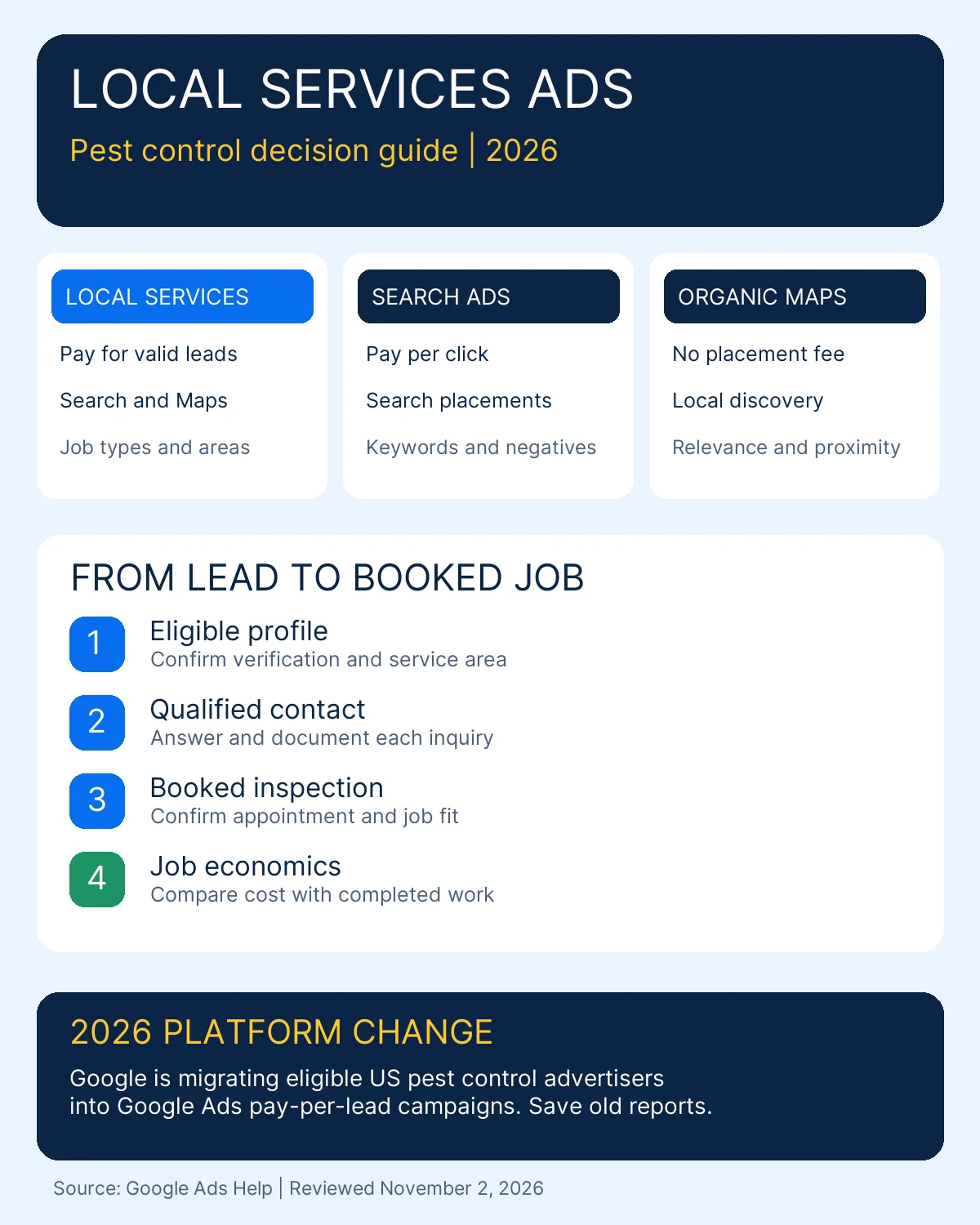
November 2026 update: Google is moving Local Services Ads into Google Ads as specialized Performance Max campaigns with pay-per-lead goals. Pest control is among the US categories included in the rollout that began in August 2026. Some advertisers have migrated and others may still use the older dashboard. The billing model remains pay per valid lead, but account management and reporting are changing.
Key takeaways
- Confirm eligibility and verification before budgeting.
- Measure cost per booked and completed job, not only charged leads.
- Compare Local Services Ads, standard Search Ads and organic Maps separately.
- Export old Local Services Ads performance reports before migration.
- Start with services and areas that match your crew’s capacity.
Are Local Services Ads worth it for a pest control company?
They can add a useful source of customer conversations when the phone rings with requests your team can handle. A provider offering termite inspections, routine residential treatments, mosquito control or rodent service may reach customers who want to contact a local business now. Google lists pest control among eligible US home-service categories, although availability and onboarding requirements vary.
Think of the product as a way to buy opportunities for conversations, not guaranteed appointments. A caller might compare several companies, ask for an unsupported treatment or decline your estimate. The office still needs to qualify the request, confirm the address, explain next steps and follow up. If staff regularly miss calls, more advertising may only increase wasted opportunities.
The most useful question is whether your combined cost per completed, profitable job is acceptable after advertising, management and lead-handling costs. Establish that ceiling using your actual job economics. Avoid copying another operator’s claimed cost per lead without knowing its market, services and booking rate.
How do Local Services Ads work in late 2026?
Historically, Local Services Ads connected nearby searchers with providers based on service categories and geographic coverage. Advertisers generally paid for valid contacts, such as qualifying calls, messages or booking requests, instead of ordinary clicks. Google’s migrated pay-per-lead campaigns preserve that basic model and continue serving in local positions on Google Search and Maps, not across the full standard Performance Max network.
The migration matters for operations. Google began moving selected US home-service advertisers, including pest control, in August 2026. The rollout expands through late 2026, with other accounts and markets planned for 2027. After migration, budgets, service settings, notifications and leads move into Google Ads, while some core business details sync from Google Business Profile.
Google says historical Local Services Ads campaign reports will not automatically appear in the new Google Ads reports. Export or capture your previous spend, lead counts and cost-per-lead trends before the account moves. Past customer lead history is expected to transfer. Check bidding too: manual bidding and category-level target CPA controls are being retired in the migrated format.

What does a pest control business need to qualify?
Start by checking whether the service category and local market are eligible. Google may require business screening and verification, including registration, relevant licensing and other checks appropriate to the business and jurisdiction. Do not assume a license in one county or state covers all advertised locations. Verify current requirements in the account rather than relying on a generic checklist.
The newer Google Verified badge indicates completion of applicable Google screening. It is not a guarantee of treatment quality or a promise that customers will book. Google describes limited pre-badge ads for some categories that meet preliminary requirements; never present those listings as fully verified.
Keep your business name, phone number, operating hours and actual service areas accurate. Do not list distant cities just to increase exposure. Major changes to the name or address may trigger another review. Consult the official US Local Services Ads onboarding guidance before spending.
Local Services Ads vs Search Ads vs Google Maps: what changes?
These channels may appear near one another in search, but they have different billing and management rules. Standard Google Search Ads typically charge for clicks and give advertisers keyword, match-type, negative-keyword and landing-page controls. Local Services Ads use eligible service types and geographic targeting instead of manually selected keyword lists. Organic Maps listings are not purchased placements.
| Channel | Primary cost model | What you control | What to measure |
|---|---|---|---|
| Local Services Ads / migrated pay-per-lead | Charged valid leads | Job types, areas, schedule and eligible settings | Qualified bookings and completed jobs |
| Standard Search Ads | Usually pay per click | Keywords, negatives, ads and landing pages | Qualified bookings and completed jobs |
| Organic Google Maps | No charge for organic placement | Profile accuracy and legitimate local presence | Calls and booked jobs attributable to Maps |
A practical marketing plan may combine all three. Search Ads offer direct query control for termite inspections or emergency rodent work. A reliable Google Maps presence helps customers find business information. Local Services Ads add another contact route if you qualify. Avoid double-counting a customer who interacted with multiple channels before calling.
How much should you budget for pest control Local Services Ads?
Google does not publish one universal national cost per pest control lead. Charges vary with geography, service type, competition and the inquiry. A termite inspection provider in a competitive city cannot safely copy a budget from a smaller general pest operator. Use the estimates shown in your own account, then replace those estimates with actual booked-job data.
For migrated accounts, Google converts previous weekly budgets to daily averages. Its published rule caps monthly spending at the daily average multiplied by 30.4. For example, $20 per day corresponds to $608 per month; $35 corresponds to $1,064; and $50 corresponds to $1,520. These are illustrative billing calculations, not recommended budgets or promises of lead volume. Management fees, call software and staffing remain separate expenses.
| Illustrative daily average | Monthly limit (× 30.4) | Planning question |
|---|---|---|
| $20 | $608 | Can the office answer every inquiry? |
| $35 | $1,064 | Which jobs have healthy contribution margins? |
| $50 | $1,520 | Can technicians absorb more inspections? |
Set a maximum acceptable acquisition cost using labor, travel, materials and expected customer value. For recurring plans, use actual retention records rather than assuming every new customer will renew. For one-time jobs, calculate profitability from the completed work without speculative lifetime value.
Which job types and service areas should you advertise?
Start with work your technicians are licensed, equipped and available to perform. Termite inspections, bed bug treatment, mosquito control, rodent removal and routine residential pest service have different customer expectations. Check the job types offered inside your account; not every pest-related term is necessarily available as a separate selection.
Review your dispatch map and separate profitable routes from areas with excessive travel. A long trip to a low-margin appointment can displace more suitable jobs. For Florida operators, consider seasonal demand and real county-level coverage, but do not claim statewide service if the company works in only a few markets.
After migration, service areas and ad schedules can be adjusted within Google Ads even while some business details sync from Google Business Profile. Recheck settings after the move. Your lead follow-up records should reveal which services generate qualified appointments and which attract poor-fit requests.
What counts as a valid lead, and can poor leads be credited?
A lead charge is not limited to a completed job. Google’s guidance describes valid contacts that can include conversations, messages, voicemails and qualifying booking requests. Certain unanswered calls may also be charged under specified conditions. A short conversation or a customer who declines an estimate is not automatically an invalid lead.
Google uses automated systems to assess lead quality and may credit some contacts. However, the current policy says credits are no longer supported simply because the requested job type or geography is not serviced. Accurate category and area settings therefore matter. Never assume every poor-fit inquiry will be refunded.
Give each inquiry a disposition: qualified and booked, qualified but not booked, unsupported service, out of area, duplicate or spam, or unanswered. Compare these records with the account’s Charged, Not charged, In review and Credited statuses. This is more useful than looking only at a lead count. Consult Google’s lead definitions and automated credit policy.
How should your team handle Local Services Ads inquiries?
Assign responsibility before enabling a campaign. Decide who answers calls during advertised hours, who handles overflow, and who reviews missed inquiries each day. Use a simple qualification script: ask about the pest problem, property type, ZIP code, urgency and preferred appointment time. Do not promise a treatment result or fixed price before any required inspection.
Urgent rodent and bed bug requests can be time-sensitive. Prompt, informed responses help customers continue the conversation, and Google recommends timely replies. Do not invent a universal five-minute ranking rule. Instead, measure your own missed-call rate and how quickly staff follow up.
Record the marketing source, inquiry outcome and confirmed appointment in a CRM. Respect privacy and consent requirements when handling call recordings or personal information. If you use call-tracking numbers, check that routing does not interfere with platform requirements. See our pest control conversion tracking guidance.
How do you test Local Services Ads for 30 days?
Treat the first month as a controlled learning period, not a deadline for guaranteed profit. During week one, confirm verification, eligible services, locations, hours, call routing and your baseline booking rate. If the account is migrating, record the migration date and save historical reports so an interface change is not mistaken for a performance trend.
In week two, review each inquiry and its disposition. In week three, compare charged leads with booked inspections and adjust coverage or lead handling where the platform permits. In week four, assess completed jobs, contribution after direct service costs, and total advertising plus management expense. Record changes so you can explain the results.
| Period | Owner action | Evidence to retain |
|---|---|---|
| Week 1 | Verify account and routing | Settings, schedule and baseline |
| Week 2 | Audit every contact | Call outcomes and reasons not booked |
| Week 3 | Improve qualification | Appointments and service-area fit |
| Week 4 | Evaluate economics | Charges, completed jobs and contribution |
A month may be too short to judge seasonal work or a small account with only a handful of inquiries. Extend the test when the sample is limited. Avoid making major decisions from two or three calls or assuming a seasonal fluctuation reflects the advertising product itself.
How do you calculate whether these leads are profitable?
Divide advertising charges by the number of completed jobs attributed to the campaign. Add agency fees and other incremental marketing expenses for a fuller acquisition cost. Compare that total with the contribution each job produces after labor, materials and travel. A low cost per lead means little if most inquiries never become paid work.
Consider an illustrative example: $800 in advertising generates 16 charged leads, eight qualified conversations, five booked inspections and four completed jobs. Ad-only cost per charged lead is $50, but ad-only cost per completed job is $200. If management adds $200, combined acquisition cost per completed job becomes $250. These are sample calculations, not actual market results.
Compare this channel with your Google Ads campaigns using the same booking and cost definitions. Do not count one customer twice after multiple marketing interactions.
When should a pest control business choose another channel first?
Delay expansion if staff cannot answer calls, verification is incomplete, the company cannot serve the advertised area, or booked jobs are not tracked. Fix those issues first. Search Ads may offer better control for narrowly defined services that need specific keywords and landing pages.
Improve your Google Maps foundation and website when business information or service pages are weak. Pest Control Digital can review eligibility, PPC setup and lead tracking before recommending a controlled test. Explore pest control PPC management or request a free growth audit. No ranking, lead volume or revenue is guaranteed.
Frequently asked questions
Are Local Services Ads available for pest control?
Google lists pest control as an eligible US category, but local availability and verification requirements vary.
Do Local Services Ads charge per click?
No. The specialized model charges for valid leads rather than ordinary clicks. A charged lead does not guarantee a booking.
Are Local Services Ads moving to Performance Max?
Yes. Google began migrating selected US home-service advertisers in August 2026. Account timing differs.
Will my historical reports transfer?
Google says older campaign performance reports do not automatically transfer. Export them before migration.
Can an out-of-area lead be credited?
Google no longer supports credits solely because a lead requests an unserved geography or job type.
Should I use Search Ads too?
Possibly. Compare qualified appointments and completed jobs while avoiding duplicate attribution.
Official sources and further reading
- Google Ads Help: 2026 Local Services migration
- Google Local Services: US eligibility
- Google Local Services: How leads work
- Google Local Services: Automated lead credits
Reviewed November 2, 2026. Check current platform settings before making advertising decisions.