Google Ads for Pest Control: Budgets, Keywords and Lead Quality
Google Ads for pest control can put your services in front of people actively searching for help, but the budget only works when you target the right jobs and measure what happens after a click. Start with your real service area, a manageable daily spend, focused keywords, and a clear definition of a qualified lead. This guide explains how to build that system without relying on guesswork.


For a wider comparison, see 12 pest control lead generation channels by cost, speed, and operational control.
Key takeaways
- Separate money paid to Google from the agency’s management fee.
- Organize campaigns around pest services, location and customer intent.
- Review search terms and negative keywords before expanding reach.
- Measure answered calls, qualified inquiries and booked jobs, not clicks alone.
- Use dispatch capacity and job economics to decide when to scale.
How should you budget Google Ads for pest control?
Begin with a spending ceiling your business can sustain while you collect useful data. Google Ads uses an average daily budget for many Search campaigns. Google says the monthly spending limit for most campaigns is 30.4 times that daily amount; the daily billed limit can be twice the average on individual days. These are platform billing rules, not predictions of how many leads you will receive.
Consider an illustrative budget of $30 a day. Its usual monthly spending limit would be $912 under Google’s 30.4 calculation, assuming the budget is unchanged and the campaign runs throughout the month. A $50 average daily budget would correspond to $1,520. These examples do not include a management fee, landing-page development, tracking software or other operating costs.
Before choosing a figure, ask what an additional booked job is worth after technician time, materials and travel. Decide how many calls the office can answer and how many inspections your team can schedule. Start with the pest categories that match available crews.
| Illustrative average daily budget | Typical monthly spending limit | Planning note |
|---|---|---|
| $20 | $608 | Small controlled test, not a lead forecast |
| $30 | $912 | Review search terms and call quality closely |
| $50 | $1,520 | Expand only when the funnel is measurable |
Which Google Ads keywords attract real pest control customers?
Start with searches that describe a service the business can actually deliver. Someone searching for “termite inspection near me” may be seeking an appointment. Someone searching “what do termite wings look like” may want information, not a technician. Both searches matter to content marketing, but they are not equally suitable for a lead-focused Search campaign.
Build groups around meaningful service distinctions: termite inspections, rodent removal, mosquito treatments, bed bug control and general recurring pest service. Match the ad to a landing page that clearly explains the same service. See our pest control landing page checklist for layout, forms, and call measurement. If a company cannot treat wildlife, do not advertise wildlife removal simply because a keyword tool suggests demand.
Use location modifiers only where they fit the actual service territory. For example, a business covering Orlando and nearby communities might test “pest control Orlando” separately from a specialized termite query. Check Google Keyword Planner for available search ideas and estimates, but treat its forecasts as planning inputs rather than guarantees.
| Search theme | Likely intent | Initial match-type test | Best next step |
|---|---|---|---|
| “termite inspection near me” | High service intent | Phrase or exact | Termite inspection page |
| “rodent removal [city]” | High service intent | Phrase or exact | Rodent service page |
| “monthly pest control service” | Recurring service research | Phrase | Recurring treatment page |
| “how to identify bed bugs” | Informational | Usually exclude from lead campaign | Educational content |
| “pest control jobs” | Employment | Negative keyword candidate | Do not buy for customer acquisition |

How do match types and negative keywords control wasted clicks?
Google Ads supports broad, phrase and exact keyword match types. Exact match is not limited to identical wording: it can match searches with the same meaning or intent. Phrase match can also include variations in meaning. Broad match reaches related searches and can widen the pool further. The right mix depends on your conversion signals, bidding strategy and tolerance for irrelevant traffic.
A practical starting approach for a tightly scoped pest control campaign is to review exact and phrase terms around specific services, then test broader reach when tracking and query review are reliable. Google specifically recommends pairing broad match with Smart Bidding, because auction signals influence how it selects opportunities.
Negative keywords help exclude unsuitable searches. Candidates may include “jobs,” “salary,” “DIY,” “free,” “training,” “wholesale,” or “pesticide supplies,” but only when those searches are genuinely outside your offer. Do not block “inspection” automatically if inspections are an important lead source. Review actual search terms and add exclusions with care: Google’s negative matching works differently from positive keyword matching and does not cover every close variant.
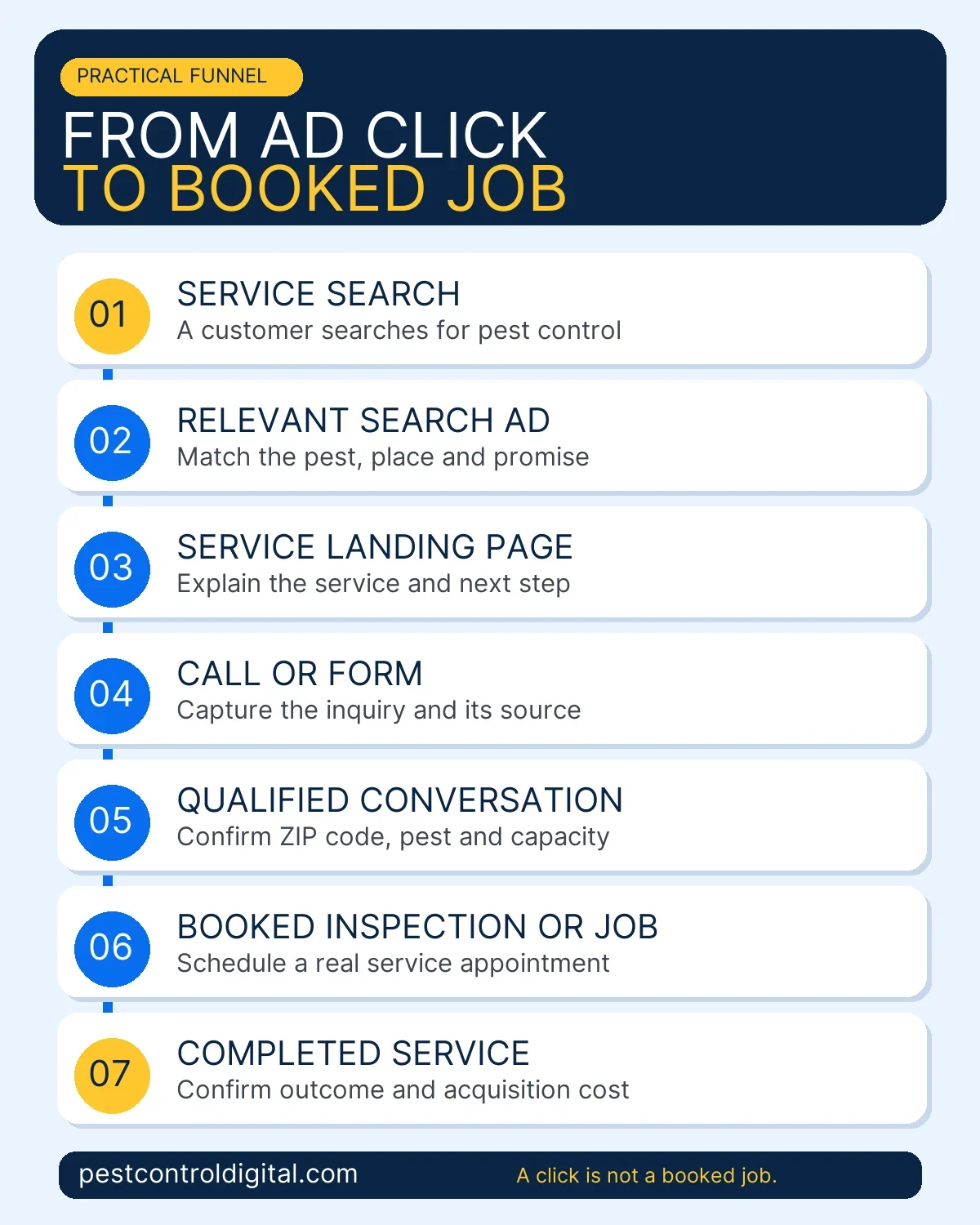
What should a click-to-job funnel look like?
The useful unit of performance is not the click. It is the path from a relevant search to a completed job. A click that ends at voicemail is not a booked job. The campaign therefore needs a connected measurement and response process.
Use this sequence: relevant search → ad click → service page → call or form → qualified conversation → scheduled inspection or treatment → completed job. Record the step where prospects drop out. A call that lasts a certain number of seconds can be a helpful proxy, but it is not proof of an appointment. Google’s call-conversion tools can use duration or eligible call-quality signals; your office still needs to verify whether the inquiry was serviceable.
Mark an out-of-area rodent inquiry unqualified; prioritize a commercial inspection that books. Connect the website to pest control conversion tracking and review call tracking before increasing spend.
The infographic above shows the stages that deserve separate reporting. It is a workflow, not a claim about conversion rates.
How do you target the right neighborhoods and operating hours?
A service-area company should advertise where its technicians can reasonably respond. Google Ads location settings can include people in a target area and people showing interest in that area. For a business that only wants nearby customers, review the “Presence” option rather than assuming the default setting matches its dispatch boundaries. Google notes that location targeting uses signals and is not perfectly accurate, so geographic reports still require monitoring.
Translate your dispatch map into campaign decisions. If your crews cover Tampa but not distant counties, use appropriate city or radius targets and exclusions where supported. Watch the location report for requests outside the real service area. Do not advertise unavailable same-day service.
Operating hours deserve similar attention. If emergency calls are answered around the clock, the business may test broader schedules. If nobody can respond after closing, running a call-first campaign late at night may create missed opportunities. You can still accept forms after hours, but the page should say when customers can expect a reply.
What makes a pest control landing page convert better?
Each paid landing page should immediately confirm that the visitor found the right service. For a termite inspection query, show termite inspection information first, not a generic agency-style homepage with every pest category. Identify the service territory, explain the inspection or treatment process in plain English, and make the next action obvious on a phone.
Put a tap-to-call number near the top and provide a short form for visitors who cannot call. Explain what happens after submission. If pricing depends on property size, infestation or inspection findings, say so instead of publishing an invented flat rate. Display only real licenses, qualifications, guarantees, testimonials and reviews that the company can document.
Mobile experience matters because many people search while dealing with an active problem. Test form submission, click-to-call, page loading and thank-you tracking on an actual phone. Use a clear confirmation message and prevent duplicate conversions when someone refreshes the thank-you page. See the pest control landing page and CRO service for the elements worth auditing.
Keep the page focused on the service and a clear next step.
How should you measure lead quality and cost per booked job?
Track the entire customer journey in a simple sheet or CRM. For each ad-generated inquiry, record the service requested, ZIP code, whether the call was answered, whether the inquiry was qualified, whether an appointment was scheduled, and whether the job was completed. Define terms consistently across staff.
Consider this illustrative example, not a benchmark: a campaign spends $900 and receives 30 recorded inquiries. Staff qualify 18, book 9, and complete 7 jobs. Cost per recorded inquiry is $30; cost per qualified inquiry is $50; cost per booked job is $100. Those figures do not establish profitability because completed-job value, margins and overhead have not been supplied.
When your systems allow it, import meaningful downstream conversions so bidding can learn from higher-quality outcomes. Google documents enhanced conversions for leads and the Data Manager API for newer offline uploads. Respect consent, privacy and access controls. The CRM and lead follow-up process should agree with the definitions used in Google Ads.
| Illustrative funnel measure | Value | How calculated |
|---|---|---|
| Ad spend | $900 | Assumed test spend |
| Recorded inquiries | 30 | Assumed tracked contacts |
| Qualified inquiries | 18 | Assumed serviceable leads |
| Booked jobs | 9 | Assumed appointments |
| Cost per booked job | $100 | $900 ÷ 9 |
What should you review each week before scaling?
Use a short operating review rather than making changes every time the click count moves. Start with search terms and the percentage of inquiries your team could actually serve. Then examine the locations generating those inquiries, call-answering gaps, landing-page problems and booked-job outcomes. Cheap clicks are worthless if they attract unserviceable inquiries.
Compare performance by service. A termite inspection, a one-time ant treatment and a recurring commercial contract have different economics. Do not force them into one target acquisition cost without considering their contribution and follow-up cycle. Record changes to explain later performance. For separate organic context, see our Orlando SEO case study and free marketing tools; neither proves paid-ad results.
Make one deliberate adjustment at a time where practical. If leads are relevant but calls go unanswered, fix the response process before raising bids. If calls are answered but mostly ask for services you do not provide, tighten targeting and page messaging. If bookings are profitable and technicians have capacity, consider testing a controlled budget increase. For related organic visibility, see our pest control SEO guide and Google Maps ranking guide.
How Pest Control Digital helps
Pest Control Digital can review search intent, campaign structure, location settings, landing pages and lead measurement for pest control operators. The goal is a transparent plan that shows where the money goes and which inquiries become service opportunities, not a promise of a particular ranking or return. Explore Google Ads management for pest control or request a practical review of your current account and website.
Frequently asked questions
How much should a small pest control company spend on Google Ads?
There is no universal minimum that guarantees results. Start with a test amount the company can sustain, confirm the service area and tracking, and compare actual qualified inquiries with the jobs the crew can accept. Separate management fees from ad spend.
Are exact match keywords guaranteed to show only for identical searches?
No. Google's exact match can include searches with the same meaning or intent, not only identical words. Review the search terms report and use suitable negatives when queries do not fit the services you offer.
Should I advertise emergency pest control after hours?
Only if the company can respond as promised or clearly explain the next available response time. A campaign that drives urgent callers to voicemail may produce paid clicks without booked jobs. Align ad scheduling with dispatch.
What is a qualified pest control lead?
A useful definition is an inquiry from someone in the actual service area who needs a service the company provides and has a realistic next step, such as an inspection or treatment booking. Record unqualified calls separately.
Do Google Ads and Local Services Ads work the same way?
No. They are different advertising products with distinct eligibility, placement and billing arrangements. This guide focuses on Google Search campaigns. Compare current requirements before combining reports.
Can conversion tracking tell me which clicks became paying customers?
It can help when the website, call tracking and customer records are connected correctly. Basic click or call conversions alone cannot prove a completed job. Import downstream outcomes where supported and respect privacy.
Want a clearer picture of your paid leads?
Get a practical review of your targeting, landing pages and conversion tracking before committing more budget.