Pest Control Landing Pages That Convert: Layout, Forms and Call Tracking
A pest control landing page should turn a specific search into a useful conversation, not force a worried homeowner through a generic website. The best layout matches the pest and location in the ad, explains what happens during an inspection, and makes calling or requesting service easy. Strong forms and call tracking then show which inquiries become actual booked work.


Key takeaways
- Build separate landing-page messages for different pest problems and customer intent.
- Show service fit, coverage, and an honest next step before decorative content.
- Keep forms short but useful for dispatch, with accessible labels and clear consent.
- Track phone clicks, real conversations, qualified leads, and booked appointments separately.
- Improve one weak step at a time instead of trusting a generic conversion-rate target.
What makes a pest control landing page different?
A landing page is the destination for a focused campaign, such as an ad for termite inspections in Tampa or an emergency rodent inquiry in Orlando. It should answer the visitor’s immediate question rather than present every service the company offers.
Google’s landing-page guidance recommends matching the destination to the ad and keywords, making contact easy, and putting useful information near the top. For pest control, that means naming the pest, the service area, and the next available step without promising an appointment slot that dispatch has not confirmed.
A termite inspection page might explain whether an inspection is offered, what areas are assessed, and how estimates are handled. A bed bug page may need preparation guidance and a discreet callback option.
Match the headline and first screen to search intent
The first mobile screen should connect the ad’s promise to a real service. A visitor who searched for “rodent inspection near me” expects a rodent-specific headline, a realistic service-area statement, and a way to ask about inspection availability.
Use a headline that states the actual offer, followed by one sentence about the process. Show a tap-to-call control and a separate request-inspection option when both are supported. Avoid an unqualified “same-day guaranteed” banner unless the business can honor that promise across the advertised locations and hours.
Place supporting proof close to the action. Suitable evidence includes the company’s real license information where applicable, its verified operating area, photographs of its actual team with permission, and genuine customer reviews used accurately. Do not add invented ratings, countdown timers, or stock photos presented as employees.
On mobile, a clear stacked layout usually gives each action more room.
Choose the promise the office can keep
Use “Request a termite inspection” when the team must confirm a time. Use “Call about current availability” when scheduling varies. Precise language may reduce irrelevant inquiries and protect the customer’s trust.
Use a page anatomy that helps customers decide
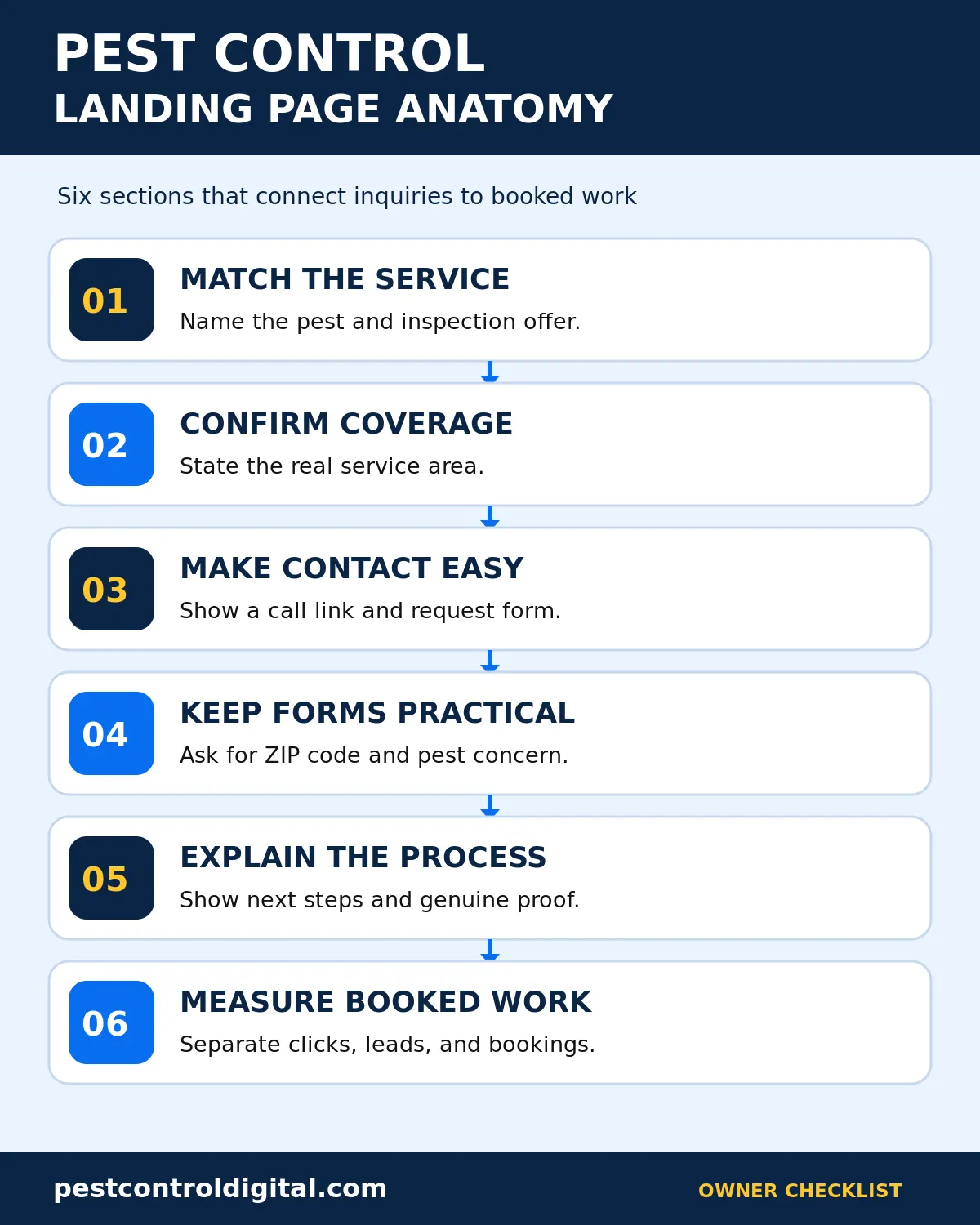
A practical layout follows the order in which customers make decisions: identify the pest problem, check service coverage, understand the inspection or treatment process, evaluate the company, and contact it.
| Page element | Customer question answered | Implementation check |
|---|---|---|
| Specific headline | Do you handle my pest problem? | Match the advertised service and intent |
| Coverage statement | Will you visit my property? | Use actual ZIP codes or service-area wording |
| Call and form options | How can I reach the team? | Test phone link and successful form receipt |
| Process explanation | What happens after I contact you? | Explain inspection, quote, and scheduling steps |
| Verifiable proof | Why should I trust this company? | Use real credentials and reviews only |
| Short FAQ | What might delay my decision? | Answer actual service and preparation questions |
The table is a design checklist, not a claim that every element raises conversions by a fixed amount.
Place the most important contact action after the opening explanation and again after the service details. Do not force visitors through a long sales story before they can request help.
Keep forms short, accessible, and useful for dispatch
A form should gather enough information to route the inquiry without turning the customer into an unpaid data-entry clerk. For a typical residential inspection request, start with name, phone or preferred contact method, ZIP code, and pest concern.
Ask only for details the office uses at this stage. Full street address, square footage, photos, and billing information can often wait until staff confirms service fit.
The W3C forms tutorial explains why each control needs an associated label. Its validation guidance also calls for helpful error messages and server-side validation. A placeholder inside a field is not a substitute for a persistent label.
After submission, show a clear confirmation explaining what happens next and when the team normally responds. Test that the message reaches the right inbox or CRM, that spam controls do not block real customers, and that failed submissions produce understandable errors.
Design call buttons around real office availability
Pest control customers often prefer to call when they see active rodents or suspect bed bugs. Show accurate business hours or a clear after-hours process. Do not claim that a call is answered around the clock when it goes to an unattended voicemail.
Use a visible, descriptive label such as “Call about rodent inspection” and make the link use the tel: format. An alternative form matters for people who cannot call or prefer written contact.
Decide what happens to missed calls before buying more traffic. If the business uses voicemail, callbacks, or an answering service, explain that workflow internally. A caller who receives no response is not a booked job, even if the ad platform records a click or call action.
Consider separate routing for emergency inquiries and routine maintenance requests. Dispatch may need a different response process for an active rodent problem than for a quarterly exterior treatment plan.
Call clicks are not completed calls
A tap on a mobile phone link shows intent to call. It does not prove that the call connected, was answered, or qualified for service. Keep these events separate in reporting.
Set up pest control call tracking without inflating results
Google Ads supports several forms of phone call conversion tracking, including calls from ads, calls to a number displayed on a website, and mobile phone-link clicks. The measurement differs: a phone-link click is not a verified conversation. Website call tracking using Google forwarding numbers requires the appropriate tagging and account configuration.
For meaningful reporting, connect campaign source to what the office actually knows. A call can be answered but outside the service area, or it can be qualified but not booked because the customer declines the inspection.
| Event | What it proves | What it does not prove |
|---|---|---|
| Landing-page view | A visit reached the page | Interest or service fit |
| Phone-link click | The visitor tapped a call control | Connected or answered call |
| Connected call | A phone conversation occurred | Qualified service inquiry |
| Form submission | An inquiry was submitted | Valid address or booked job |
| Qualified inquiry | Staff confirmed relevant service fit | Customer accepted a booking |
| Booked inspection | An appointment was scheduled | Completed service or revenue |
Use pest control call tracking and conversion tracking setup to align ad data with the CRM. If calls are recorded, disclose recording where required and apply the applicable consent and retention rules.
Measure booked inspections, not just form completions
Google Analytics distinguishes events from key events, and a completed lead form can be recorded with a generate_lead event. Google’s key-event documentation explains how important actions can be measured and used for advertising. For a pest control owner, this is only the first layer of the funnel.
Define a qualified lead before evaluating a campaign. A reasonable definition might require a relevant pest issue, a property inside the service area, and a reachable contact. Then report booked inspections separately.
Illustrative example: if a campaign spends $600 and produces 12 qualified inquiries, the cost per qualified inquiry is $50. If four of those inquiries become scheduled inspections, cost per booked inspection is $150. These are example figures, not industry benchmarks or a prediction for any market.
A termite inspection can involve a different sales process than a routine mosquito plan. Review canceled appointments and no-shows separately so a scheduled slot is not mistaken for completed revenue.
Improve mobile speed, clarity, and trust together
Mobile usability is not just a speed score. The page must load, show its main service message, and let visitors act without accidental taps or unreadable text. Compress images, avoid unnecessary third-party scripts, and check that sticky call controls do not cover the form or cookie notice.
Show real business information consistently. A visible business name, correct service area, working phone number, and accessible privacy link help customers decide whether to share contact details. If you advertise licensed services, confirm that every credential displayed is accurate for the relevant state and service.
Do not use testimonials that cannot be traced to genuine customer feedback. If you quote a review, keep its meaning intact and obtain any needed permission. Explain what an inspection establishes and what a technician must evaluate on site.
Check the form with keyboard navigation, visible labels, and clear errors. Test a slow mobile connection and common screen widths.
Test one meaningful change at a time
Begin with a baseline: traffic source, service page, phone-link clicks, connected calls, qualified inquiries, booked inspections, and response time where available. Identify the biggest failure point. If people cannot submit the form, fix that before testing headline wording. If the office misses calls, solve routing before paying for more calls.
Compare changes over a period long enough to include normal scheduling variation. Record what changed, the dates, and any campaign or weather changes that could influence demand.
Try practical experiments: move the coverage statement higher, clarify whether the offer is an inspection or treatment, shorten unnecessary form fields, or add a visible response-time explanation. Test only what the team can fulfill operationally.
For a broader website review, use the pest control website design checklist. For campaign alignment, consult the Google Ads for pest control guide and the lead generation channel comparison.
How Pest Control Digital helps with landing pages
Our pest control landing page and CRO service focuses on the steps that matter to owners: ad-to-page relevance, mobile usability, honest trust signals, practical forms, and measurement tied to booked work. We can review a page alongside its traffic source and call handling instead of treating design as an isolated task.
Start with a free growth audit to identify the clearest next improvement.
Frequently asked questions
Should every pest control service have its own landing page?
Not every variation needs a separate page. Create distinct destinations when the customer’s problem, inspection process, or service eligibility differs meaningfully. Termite inspections, bed bug evaluations, and recurring mosquito plans usually need different explanations. Avoid near-duplicate pages that only swap city names without adding useful local details.
How many fields should a pest control lead form include?
Use the fewest fields needed to determine service fit and contact the customer. Name, contact method, ZIP code, and pest concern are often enough for a residential first inquiry. Commercial accounts may require facility type. Test the form with your dispatch team and remove information that nobody uses before the callback.
Should a landing page show pricing?
Show accurate prices when the service has a genuinely fixed scope and the business can honor them. Many pest treatments depend on property conditions, infestation extent, and inspection findings. In those cases, explain how estimates work rather than inventing a starting price that will not apply to most customers.
Does a click-to-call count as a lead?
It counts as a phone-link interaction, not necessarily a completed call. The visitor might cancel before connecting, call after hours, or be outside your service area. Track answered calls and qualified conversations separately, then reconcile them with scheduled inspections. That distinction makes campaign decisions more reliable.
Can one landing page serve multiple cities?
Yes, when the company genuinely serves those locations and the service process is substantially the same. Make coverage clear and do not claim a physical office in every city. Create location-specific content only where it helps customers understand routing, availability, local service conditions, or other meaningful differences.
What should I fix first if ads get clicks but no bookings?
Check whether the page matches the ad, the phone number works, forms reach staff, and callbacks happen. Then review whether inquiries are within your coverage area and whether the offer fits the pest problem. Fix operational breaks before redesigning the entire page or raising the campaign budget.
For a practical way to separate call clicks from qualified inquiries and booked work, see our pest control call tracking guide.
Want a clearer path from clicks to booked inspections?
Get a practical review of your pest control landing page, lead forms, and call measurement.