Pest Control Lead Generation: 12 Channels by Cost & Speed
Pest control lead generation works best when a company matches its marketing channels to the jobs it can actually service. Search ads can capture an urgent rodent call, while referrals and customer reminders can support recurring plans. There is no universal cheapest or fastest channel. Compare twelve options by relative cost, speed, and control, then choose and measure them.


Key takeaways
- Count qualified service inquiries and booked jobs, not just clicks or raw calls.
- Use high-intent search channels when technicians can handle new urgent work.
- Build organic visibility and customer relationships alongside paid campaigns.
- Compare channels using your own costs and closing rates, not generic lead-price claims.
- Fix missed calls and weak follow-up before increasing advertising spend.
What counts as a qualified pest control lead?
A qualified lead is a person or organization that needs a service you offer, inside a location you can serve, and is reasonably able to book. Someone requesting a termite inspection in your service area may qualify. A vendor selling supplies, an out-of-state caller, or a request for wildlife removal you do not provide should not count as an equally valuable lead.
Track the steps separately: initial inquiry, answered conversation, qualified request, estimate or inspection scheduled, and completed job. A long phone call is not automatically a sale. Google Ads, for example, supports call conversion tracking, but the owner still needs to distinguish a useful conversation from a misdialed or irrelevant call. See the pest control conversion tracking service for the measurement work involved.
Record why inquiries fail: outside area, wrong pest, unavailable appointment, or spam. Review them weekly.
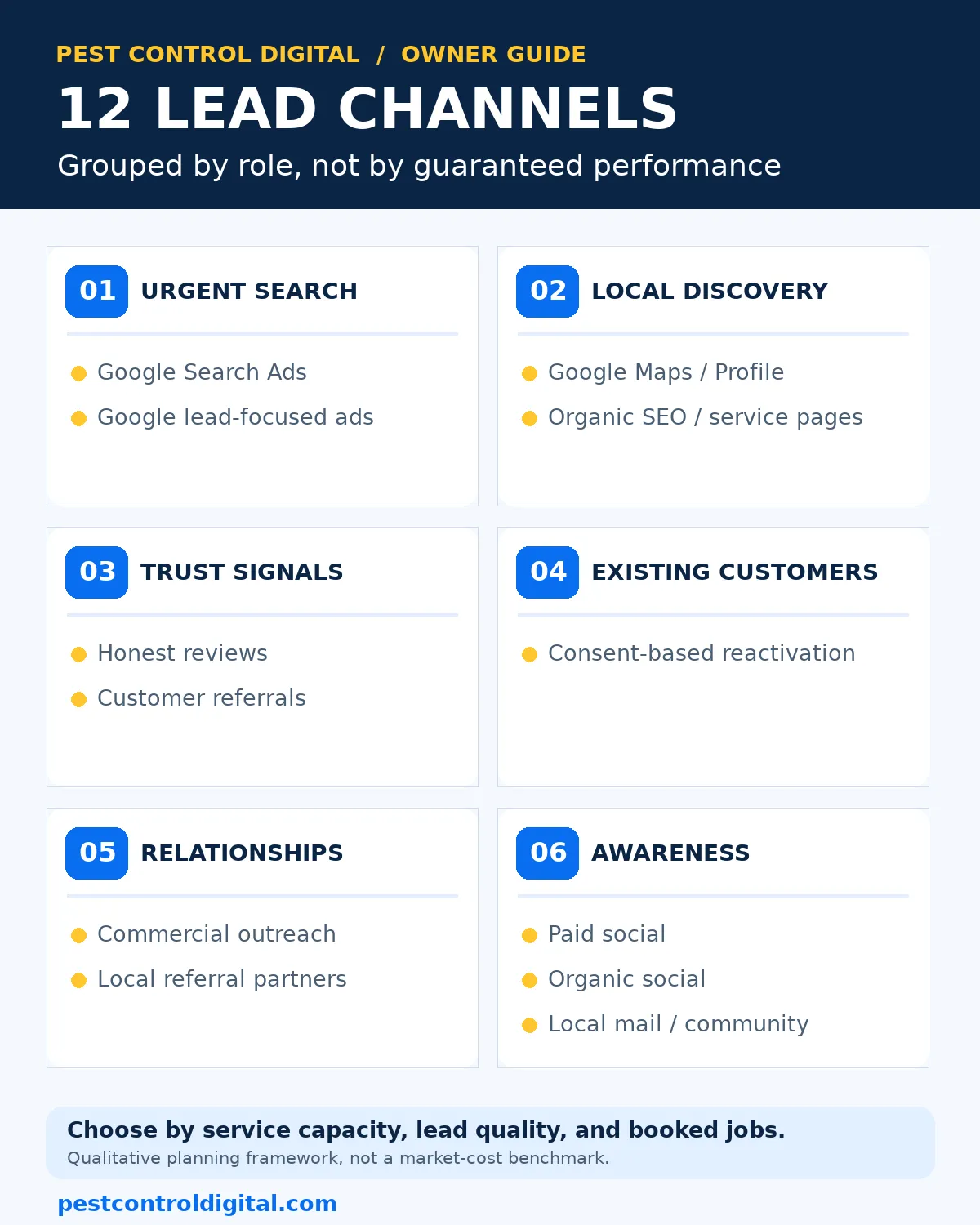
How do twelve pest control lead generation channels compare?
This is an editorial planning framework, not an industry benchmark. Cost means the relative mix of media spending and staff or agency work. Speed describes how soon a channel might produce an inquiry after competent setup, not a promised outcome. Control means how directly you can adjust targeting, timing, messaging, or follow-up.
| Channel | Relative cost | Potential speed | Control | Best use |
|---|---|---|---|---|
| 1. Google Search Ads | Higher ongoing media cost | Potentially fast | High | Urgent service searches |
| 2. Google lead-focused ads | Variable paid-lead cost | Potentially fast after eligibility | Medium | Local service inquiries |
| 3. Google Maps / Business Profile | Ongoing management work | Variable | Medium | Nearby service discovery |
| 4. Organic SEO and service pages | Ongoing content and technical work | Usually gradual | Medium | Longer-term demand capture |
| 5. Honest review requests | Lower media cost, staff time | Gradual | Medium | Trust and conversion support |
| 6. Customer referrals | Lower media cost, staff time | Variable | Medium | Warm introductions |
| 7. Existing-customer reactivation | CRM and messaging cost | Potentially fast | High | Renewals and seasonal service |
| 8. Commercial prospect outreach | Sales time and materials | Often slower | High | Property and facility contracts |
| 9. Local referral partners | Relationship-building time | Variable | Medium | Realtor and contractor referrals |
| 10. Paid social advertising | Paid media plus creative | Potentially fast | High | Seasonal awareness and offers |
| 11. Organic social content | Staff and production time | Usually gradual | Medium | Education and credibility |
| 12. Local mail and community outreach | Printing, event, or staff cost | Variable | Medium | Defined neighborhoods |
A homeowner may encounter several channels before booking. Avoid counting one customer multiple times.
Which channels can capture urgent pest control demand?
Termite inspections need a different booking approach from routine pest calls. Our year-round termite company marketing guide explains how to plan for local swarm periods, inspection capacity and follow-up.
Google Search Ads can target searches such as emergency rodent removal or bed bug treatment, subject to campaign eligibility and targeting. Write ads around services you actually perform and use negative keywords to reduce unrelated searches. A dedicated landing page should show service area, contact options, hours, and what happens after the call. Read the pest control Google Ads guide for keyword and lead-quality planning.
Google lead-focused service ads may be another option where the relevant format and pest-control category are eligible. Google has changed parts of its local lead advertising offering, so check current account availability and billing rules rather than assuming every business can enroll in the same product. The local service advertising explainer covers important distinctions.
Paid visibility does not guarantee calls. Narrow campaigns when dispatch cannot answer or technicians are fully booked.
How do Maps, organic search, and reviews build demand?
An accurate Google Business Profile shows customers your services, hours, and service area. Google says local results mainly reflect relevance, distance, and prominence; organic Maps rankings cannot be purchased. Keep your name, eligible address or service area, category, phone, and hours accurate. Review the Google Maps ranking guide.
Organic service pages should answer specific customer needs, not repeat city names. A termite page can explain inspections; a rodent page can cover exclusion and follow-up. Prioritize useful, original answers.
Reviews support trust, but requests must be honest. Google prohibits incentives in exchange for posting, changing, or removing reviews. Ask actual customers for feedback without screening for only happy responses. The FTC also prohibits deceptive review practices. See review and reputation marketing for compliant processes.
A published case study for Impressive Exterminating reports an increase in estimated organic traffic from 47 to 153. That is an estimate, not a documented increase in calls, bookings, or revenue, and it cannot establish what another company will achieve.
Can existing customers and referrals outperform new traffic?
They can be worth testing first because the relationship already exists. A customer who previously purchased mosquito treatment may need another seasonal visit, while a homeowner who received rodent exclusion may have questions about follow-up monitoring. Send relevant reminders only when the customer has permitted the contact method and applicable marketing rules are met.
Record service history, contact consent, follow-up dates, and outcomes in a CRM. Separate genuine service reminders from promotional messages, and avoid generic blasts.
Referrals work differently. Make it easy for satisfied customers to share your contact information, but do not confuse referrals with paid or incentivized reviews. If you operate a referral reward program, describe its terms accurately and check local requirements. Track referred inquiries in the same booking process as paid leads. Learn about CRM and lead follow-up before adding more outreach volume.
Where do commercial outreach, partners, and social media fit?
Commercial pest control usually has a different buying process from emergency residential work. Property managers, restaurants, warehouses, and facilities teams may need documented service plans, vendor qualifications, insurance information, and a clear point of contact. Research accounts individually, then approach the appropriate decision-maker with a specific service proposition. Do not assume a residential ad campaign will win a multi-site contract.
Referral partners include real estate professionals and maintenance contractors. Build transparent relationships, avoid misleading endorsements, and measure qualified inspections rather than introductions alone.
Paid social can introduce a seasonal mosquito program to a defined audience, while organic social can explain prevention, show authentic field work, and answer common questions. Neither should be treated as equivalent to someone searching for urgent treatment. Local mailers and community outreach may fit dense service routes, but calculate production and staff costs before deciding that they are inexpensive.
How should a pest control owner choose the first two channels?
Use a capacity-first decision instead of a generic marketing mix. Start with the services your team can fulfill, the zip codes that make operational sense, and the kinds of inquiries your office can answer promptly. Then choose one channel for near-term demand and one for durable visibility or retention. A small operator should not copy the budget allocation of a regional franchise.
| Business situation | First priority | Second priority | Reason to reconsider |
|---|---|---|---|
| Empty urgent-service slots | Focused search advertising | Phone handling and landing page | Too many unqualified calls |
| Strong repeat-customer base | Consent-based reminders | Referral process | High opt-out or poor relevance |
| Weak local discovery | Business Profile accuracy | Useful local service pages | Eligibility or service-area issues |
| Commercial growth target | Account-based outreach | Commercial service content | No sales capacity for long cycles |
| High traffic, few bookings | Call and form audit | Conversion improvements | Most traffic is outside service area |
A two-crew company already fully booked for termite work may improve scheduling or promote another service rather than purchase more termite inquiries.
How do you measure cost per booked job instead of cost per lead?
Start with a simple ledger: channel, spend, inquiries, qualified inquiries, booked jobs, completed jobs, and contribution after direct service costs. Where a customer interacts with several channels, choose a consistent attribution approach and document its limitations. Call tracking helps, but Google explains that some mobile phone-click conversions measure the click rather than a completed call.
Here is an illustrative example, not a benchmark: a campaign spends $600, receives 20 inquiries, qualifies 12, and produces 4 completed jobs. The cost per inquiry is $30, cost per qualified inquiry is $50, and cost per completed job is $150. Whether that is sustainable depends on contribution per job, repeat service, overhead, and cash flow.
Use the same definitions for paid ads, referrals, Maps, and reactivation. A referral channel may have little media spend but still requires staff time. A high-intent paid campaign may cost more per inquiry but produce a higher proportion of relevant requests. Avoid making decisions from a single week with a small sample.
What should the first ninety days look like?
During the first month, audit the website, Business Profile, service areas, lead sources, and call handling. Establish qualification rules and correct broken forms, wrong phone numbers, confusing service pages, or missed-call follow-up. The pest control website design guide provides a page-by-page review before adding traffic. Choose a small set of services and locations to measure consistently.
During the second month, run a controlled channel test while improving one durable asset, such as a useful termite page or an accurate local profile. Review actual search terms, qualified inquiries, appointment availability, and reasons leads fail. Do not expand targeting simply because a campaign can spend more.
During the third month, compare completed jobs and operational burden. Keep sustainable channels, revise poor targeting, and review results with dispatch. These phases are not performance promises.
How Pest Control Digital helps
Pest Control Digital reviews local visibility, paid campaigns, website conversion paths, and follow-up processes together. A useful engagement begins with an audit and a prioritized scope rather than an automatic recommendation to buy every channel. Explore pest control marketing services and the free marketing tools, then request a focused review of your actual service area and capacity.
For seasonal offers, see our mosquito control marketing timeline for a pre-season booking and route-capacity plan.
Frequently asked questions
What is the fastest pest control lead generation channel?
Search advertising can sometimes capture existing demand quickly after a campaign is eligible and configured, but it cannot guarantee inquiries. Existing-customer reminders may also work quickly for businesses with permission to contact customers. Check dispatch availability and bookings.
Is Google Maps free for pest control companies?
Creating and managing an eligible Google Business Profile does not require paying Google for an organic local ranking. However, accurate setup, photos, website improvements, review responses, and ongoing management take time. Local visibility depends on relevance, distance, and prominence, not a paid ranking fee.
How much should I spend on pest control leads?
Start with your job contribution, available appointments, qualification rate, and booking rate. Separate advertising media spend from management fees and staff time. Test a budget you can sustain, then adjust based on completed work rather than a generic cost-per-lead figure from another market.
Should I buy pest control leads from a third-party seller?
Only after checking whether the leads are exclusive or shared, how consent was collected, which areas and services are covered, how duplicates are handled, and what refunds apply. Measure completed jobs and customer experience before committing to volume or a long contract.
Do Google reviews generate pest control leads?
Authentic reviews can help customers assess a company and may contribute to local prominence, but no number of reviews guarantees inquiries. Ask actual customers for honest feedback without offering incentives for Google reviews. Keep your business information and service pages accurate as well.
Which channel works best for commercial pest control?
Commercial buyers often require a longer, more documented sales process. Targeted outreach, partner relationships, relevant service pages, and clear proof of operational qualifications may be more useful than a broad residential promotion. Track qualified site assessments and contract opportunities separately from household calls.
For a practical way to separate call clicks from qualified inquiries and booked work, see our pest control call tracking guide.
Find the right lead channels for your service area
Get a practical review of your local visibility, calls, website, and available capacity.
Sources and methodology
Cost, speed, and control are qualitative judgments, not industry averages. Platform rules and measurement claims were checked against these primary sources: