Mosquito Control Marketing: Sell the Season Before It Starts
Mosquito control marketing works best when homeowners can find, understand, and book a seasonal service before mosquito complaints peak. Build your offer around local weather patterns, route capacity, clear treatment expectations, and a simple booking process. In Florida, warm conditions can bring mosquito activity early, but timing varies by area and year. This guide shows how to plan without promising a mosquito-free yard.


Key takeaways
- Start planning from local mosquito activity and operational capacity, not a fixed national start date.
- Build pre-season messages around inspections, source reduction, and clearly explained recurring services.
- Separate urgent mosquito complaints from customers considering a seasonal plan.
- Track qualified inquiries, appointments, completed visits, and renewals rather than clicks alone.
- Make every health, safety, and treatment claim accurate and supportable.
Why mosquito control marketing must begin before the rush
Seasonal mosquito demand can move faster than a small service team can respond. A customer who first sees your company after the first unpleasant backyard gathering may want an immediate appointment, while another homeowner is willing to schedule a recurring program before outdoor events begin. Pre-season work gives you time to explain the service, test your booking form, verify the phone number, and prepare route coverage without paying to attract calls you cannot answer.
Do not confuse a marketing calendar with a biological forecast. The University of Florida’s April 2025 mosquito-season guidance notes that eggs may begin hatching when temperatures stay above 50 degrees Fahrenheit, with activity starting as early as February in some Florida areas. That is a useful reason to watch conditions, not a claim that every Florida neighborhood follows the same date. Rainfall, species, habitat, and temperature matter. Ask your operations team what it saw last year and compare that experience with local weather and public-health information.
The useful commercial goal is not simply “more mosquito leads.” It is enough geographically concentrated work to fill available visits at a sustainable cost. Plan ahead with seasonal pest control campaigns.
Build a mosquito season timeline from local signals
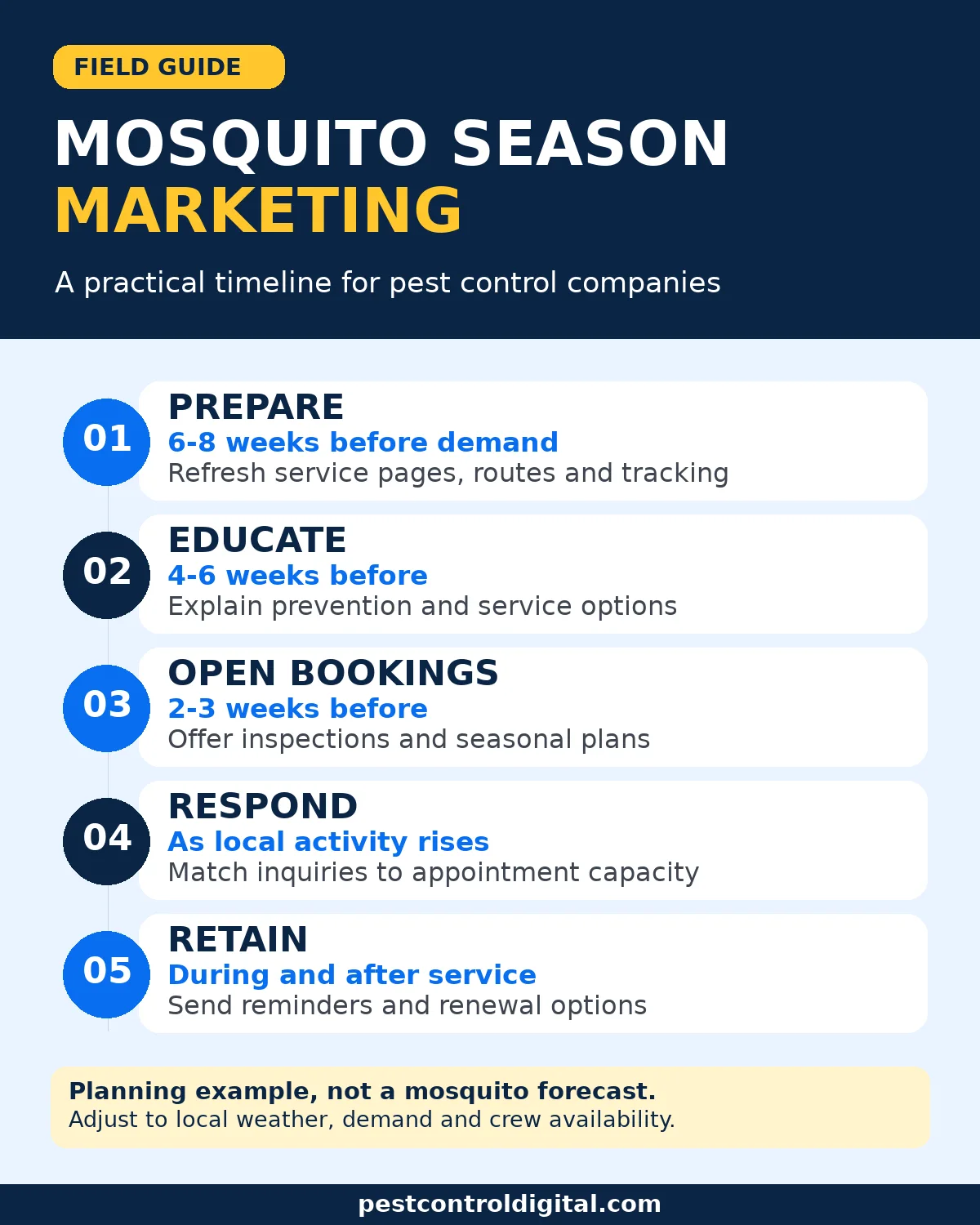
A seasonal timeline should be a working operations plan, not a promise that mosquito populations will rise on a particular day. For each service area, monitor warmer periods, recent rain, previous booking patterns, and the first inbound mosquito questions. University of Florida IFAS has explained how major rain events can support mosquito development and why increased mosquito encounters may follow. Your company can use these signals to decide when to publish educational content, begin paid tests, and open more route slots.
Document the trigger that moves a campaign from preparation into active booking, and identify who is authorized to change the budget.
| Planning stage | Suggested timing | Marketing action | Operational check |
|---|---|---|---|
| Prepare | About 6–8 weeks before expected local demand | Refresh service page, reviews process, and tracking | Confirm treatment scope and crew capacity |
| Educate | About 4–6 weeks before | Publish source-reduction tips and plan explanations | Confirm approved customer information |
| Open bookings | About 2–3 weeks before | Promote inspections and recurring-service inquiries | Reserve realistic appointment windows |
| Respond | When local activity rises | Prioritize high-intent calls and local search | Monitor missed calls and route availability |
| Retain | During and after active service | Send service reminders and renewal options | Record completed visits and customer preferences |
Write a mosquito service offer people can evaluate
Your landing page should make those answers easy to find without overstating what treatment can accomplish. Explain the difference between a one-time visit for a planned outdoor event and an ongoing seasonal program, if your company actually offers both. Avoid suggesting that every customer needs the same package.
Educational language should reflect integrated mosquito management. The CDC describes an approach that combines surveillance, source reduction, control at different life stages, and evaluation. A private residential provider may not deliver every part of a public mosquito-control program, so do not imply that it does. Describe only the inspection, recommendations, applications, and follow-up that your licensed team is authorized and equipped to provide. Never claim that a yard can be made permanently mosquito-free or that treatment prevents a particular disease.
Use a clear call to action such as “Request a mosquito service quote” or “Check seasonal appointment availability.” A short form can ask for ZIP code, service address, preferred contact method, and whether the customer is considering a one-time or recurring service. See the pest control landing-page and CRO service for ways to reduce booking friction.
Match search and advertising to the customer’s intent
Someone asking why mosquitoes appear after rain may want information. Someone searching for a mosquito treatment company near their home may be ready to speak with a provider. Build distinct messages for those needs. Informational articles can explain prevention and point to the service page; commercial pages should describe availability, service area, and the next booking step.
Searches for government mosquito-abatement offices, DIY product instructions, or unrelated medical questions may not match a residential treatment service. Use geographic settings that reflect real routes, and avoid writing location claims for cities where technicians cannot reasonably work. Your Google Ads for pest control campaign should connect each ad group to a relevant page, not send every search to the homepage.
| Customer intent | Example search theme | Best page or message | Meaningful measurement |
|---|---|---|---|
| Learning | Why mosquitoes increase after rain | Educational prevention guide | Engaged visits and service-page clicks |
| Comparing | Seasonal mosquito treatment options | Program details and clear quote process | Qualified quote requests |
| Ready to book | Mosquito control service near me | Local service page with phone and form | Booked appointments |
| Existing customer | Next mosquito treatment appointment | Service reminder or customer portal | Completed visits and renewals |
The table describes intent categories, not measured conversion rates. Validate them using your own call recordings, form fields, and search-term reports. A small campaign with high-quality inquiries can be more useful than broad traffic that does not fit your service model.
Use Google Maps and local proof without manufactured reviews
Keep the business name, phone, operating hours, service areas, and website destination accurate. The profile should reflect the actual business rather than an invented office or a keyword-stuffed company name. Add genuine service photos when permitted and make sure the website explains mosquito work in plain language. A visitor should be able to move from the profile to a relevant page without guessing which service to select.
Ask customers for honest feedback after a real service experience, without screening out negative opinions or offering rewards for favorable ratings. The Federal Trade Commission’s consumer-review rule, effective October 21, 2024, addresses fake reviews, sentiment-conditioned incentives, and other deceptive practices. Do not copy testimonials from other providers, invent five-star quotes, or present a generic stock image as a satisfied local customer. Real proof may include clearly identified technician photos, documented service processes, and accurately described licensing information.
Local visibility is only useful if the next step works. Check the call button, contact page, and booking hours on a mobile phone. If your office closes before seasonal inquiries peak, explain when a callback will happen. Learn more about Google Maps SEO for pest control and the earlier Google Maps ranking guide.
Coordinate marketing with technicians and route capacity
Before launching a promotion, agree on the maximum number of appointments the team can accept in each ZIP code, which dates are already committed, and what happens if weather forces rescheduling. Avoid advertising “same-day” or “next-day” service unless your operation can consistently support that claim.
Consider an illustrative capacity exercise, not a market benchmark. If three routes each have eight potential visit slots per week, there are twenty-four weekly slots. Across four weeks that is ninety-six potential slots; if seventy-two are already committed, only twenty-four remain before cancellations, weather and travel are considered. The numbers are hypothetical. Replace them with dispatch data, then use the remaining capacity to guide the campaign’s daily inquiry target. More inquiries than available appointments can damage customer experience and waste media spend.
For service areas that are far apart, group booking options by route rather than accepting every inquiry indiscriminately. Keep promotional promises consistent with dispatch capacity.
Turn seasonal inquiries into a clear follow-up system
Assign responsibility for answering calls, responding to forms, and recording whether each contact fits the service area. Keep the first reply practical: confirm the address, ask what kind of service is needed, explain the next step, and avoid promising a result before an inspection. If you use automated text messages, respect applicable consent and communication rules and provide an easy way to stop messages.
Separate new prospects, customers awaiting service, and past customers who may want to renew. Existing customers may benefit from a reminder about an upcoming appointment, approved preparation instructions, or a simple renewal discussion. Monitor whether customers actually find the messages useful.
Review conversion tracking for pest control so calls and forms can be connected to bookings. If the team uses a CRM, document the source, service type, ZIP code, status, and next action consistently. A reliable handoff from marketing to dispatch often matters more than adding another advertising channel. See the lead generation channel comparison for broader options.
Measure completed visits and renewals, not just seasonal clicks
Choose a small scorecard before the first campaign goes live. Useful measures include qualified mosquito inquiries, calls answered, quote requests, appointments booked, completed visits, cancellations, recurring-plan enrollments, and renewals. If the company serves several territories, compare them separately; one area may have strong demand but too little technician capacity to accept additional jobs.
A click, call, or form submission is not automatically a customer. Mark duplicate contacts, wrong-number calls, spam, out-of-area inquiries, and requests for services you do not provide. When possible, connect a booking to the original source without exposing personal information in public reports. Weather-related shifts are normal and should be recorded as context, not used as an excuse for every weak result.
Compare the contribution from completed work with acquisition and fulfillment costs. If a seasonal plan creates recurring visits, consider the servicing obligations as well as the upfront sale. A workable budget must support reliable service.
How Pest Control Digital helps with mosquito control marketing
Pest Control Digital can review the seasonal search opportunity, local visibility, landing pages, advertising structure, and call-to-booking process for a mosquito control business. The first recommendation may be to repair an existing booking flow, update a service page, or plan a controlled pre-season campaign rather than buy every channel at once. Explore seasonal pest control marketing services and the pest control business types we support. The next step is a practical audit of your current website and inquiry process.
Frequently asked questions
When should a mosquito control company start advertising?
Start preparation before your expected local demand, then adjust based on weather, prior bookings, and available technicians. A six-to-eight-week planning window is an operational suggestion, not a scientific forecast. Florida can experience early activity, while cooler markets may follow a later pattern.
Should I sell a seasonal plan or a one-time mosquito service?
Offer only the service models your team can deliver. A seasonal plan may suit customers seeking ongoing scheduled visits, while a one-time service may suit a particular event or immediate concern. Explain treatment scope, intervals, limitations, pricing terms, and cancellation policies before a customer commits.
Which marketing channel should I prioritize first?
Fix basic conversion problems before expanding spend: make sure the phone works, service areas are accurate, and booking requests receive a response. Then evaluate Google Maps, local search pages, paid search, and existing-customer follow-up according to the demand and capacity in your own business.
Can mosquito treatment eliminate every mosquito or prevent disease?
Do not promise either outcome. The CDC describes integrated mosquito management as a combination of approaches, including source reduction and control at different life stages. Marketing claims should reflect the specific licensed services offered, applicable product labels, and realistic limitations.
How do I know whether a seasonal campaign is profitable?
Track qualified inquiries through booked and completed visits, then compare the contribution from that work with advertising, management, and fulfillment costs. Include repeat visits and rescheduling obligations. Treat clicks and form fills as diagnostic signals, not proof of profitable customers.
What should a mosquito service landing page include?
Include the actual service area, a clear description of the treatment process, limitations, appointment availability, genuine proof of service, a prominent phone number, and a short quote form. Separate recurring and one-time options where relevant. Check the entire flow on a mobile phone before promoting it.
Prepare your next mosquito season with a clear plan
Find out where your website, local visibility, and booking process need attention before you increase spend.