
The Seasonal Pest Control Marketing Calendar, Month by Month
Seasonal pest control marketing works best when your campaigns follow local weather, actual service demand, and your technicians’ capacity rather than a fixed national pest calendar. A month-by-month plan gives your team time to update pages, schedule reminders, prepare ads, and handle calls before customers need urgent help. This guide provides a practical US planning framework, not a claim that every pest peaks everywhere in the same month.


Key takeaways
- Build your calendar around your service territories, not a single nationwide weather assumption.
- Prepare relevant landing pages and customer reminders before local demand changes.
- Keep year-round services visible even when a seasonal campaign is active.
- Use booked inspections and completed jobs, not clicks alone, to evaluate results.
- Review pest identification and treatment claims with your licensed operations team.
How should a pest control company plan its marketing year?
Start with a list of services your company actually provides: general pest control, termite inspections, mosquito programs, rodent exclusion, bed bug work, or commercial accounts. Then map each service to your locations, appointment availability, and historical inquiries. A campaign for a service you cannot deliver promptly is a poor use of advertising money, regardless of search interest.
Separate three dates in your planning sheet: when a pest problem may become more noticeable locally, when homeowners begin researching solutions, and when you need creative assets ready. These dates are not necessarily identical. Your office may need lead time to train dispatchers, update pricing explanations, and reserve inspection slots before ads launch.
Use the pest control lead-generation channel comparison to decide whether a campaign needs search ads, local SEO, customer email, or a combination. A high-intent rodent inspection search requires a different response from a preventive seasonal reminder sent to existing customers.
January to March: build the foundation and prepare for spring
January: audit what actually sold
Review the prior year’s leads by pest type, ZIP code, source, booked appointment, and completed job. Identify where marketing created phone calls that never became qualified work. Refresh your service pages, check call routing, and confirm that Google Business Profile hours and service information are accurate. For northern markets, review rodent and indoor pest messaging; for warmer markets, do not assume outdoor activity has stopped.
February: prepare inspection campaigns
Prepare termite inspection content and spring prevention education where your technicians expect demand. Update the service area information on relevant pages, create realistic booking language, and collect permissioned photographs of actual inspection work. Do not announce a swarm season as a nationwide fact. The termite company marketing guide explains how to connect inspection interest with a useful landing page.
March: test the spring handoff
Check local inquiry trends weekly and adjust campaigns as conditions change. Test your form on a phone, confirm staff can answer pest-specific questions, and monitor whether the right geographic areas are generating inquiries. Keep preventive messaging educational: EPA recommends identifying pests, monitoring conditions, and considering prevention before choosing controls.
April to June: respond to local outdoor activity
April: improve relevance before increasing spend
Review spring search queries, update ant and termite page copy where those services are offered, and align paid search with the right landing pages. Avoid broad claims such as “all termites swarm in April.” Species, weather, and location matter. A useful ad explains the inspection process, the actual service territory, and how a homeowner can request an appointment.
May: prepare mosquito program demand where appropriate
CDC notes that mosquito season is generally summer through fall outside the southernmost states, which may have longer seasons. That is a national overview, not a start date for every county. Review local conditions before launching mosquito ads. Explain program scope, inspection needs, and what customers can do to reduce standing water without promising a mosquito-free property.
June: check staffing and service capacity
Keep mosquito control marketing focused on service areas you can actually cover, and measure booked work rather than clicks.
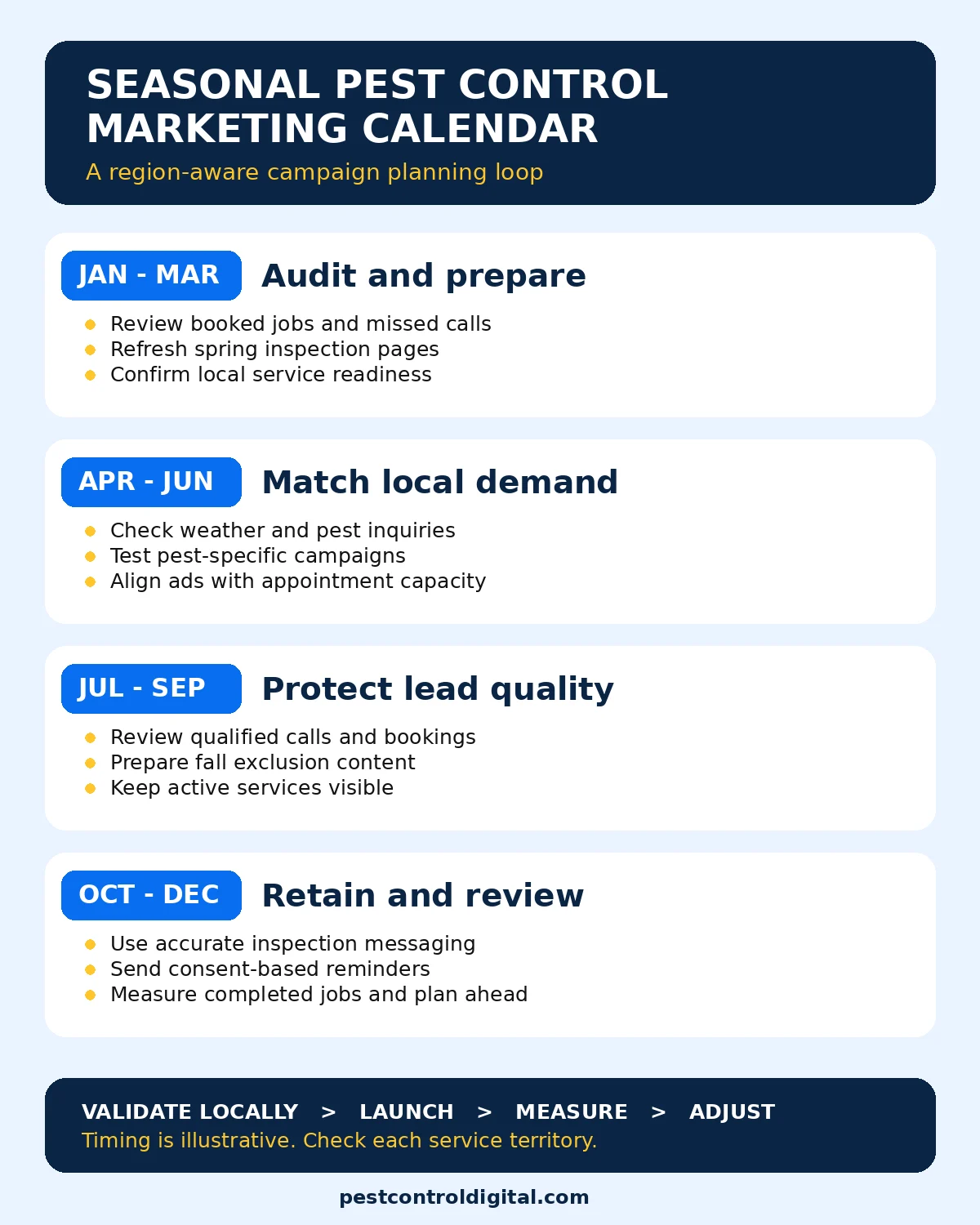
July to September: maintain service quality and prepare the fall shift
July: protect conversion quality
During busy periods, check whether incoming calls reach a trained person and whether callbacks happen when promised. Compare qualified calls, inspections booked, and completed jobs by channel. If call volume rises while booked jobs fall, inspect the intake process before buying more traffic. Use the conversion tracking and analytics service as a model for connecting advertising reports with actual outcomes.
August: build the fall campaign early
Prepare rodent exclusion explanations, property-entry inspection content, and customer reminders before local weather turns. In warm markets, mosquito and outdoor pest work may continue. Avoid replacing active summer campaigns with fall messaging simply because the calendar changes. A split campaign can serve different customer needs when capacity allows.
September: change creative when evidence supports it
Check temperature changes, customer questions, and recent jobs. If rodent inquiries are rising, update headlines to discuss inspection, entry points, and prevention. If mosquito demand remains strong, retain accurate service messaging. The urgent pest marketing guide offers a useful model for handling time-sensitive calls without making unsupported emergency promises.
October to December: focus on prevention, retention, and next-year planning
October: prioritize the right fall inquiries
Where rodent activity or entry concerns rise, use clear inspection and exclusion messaging. CDC guidance emphasizes finding and sealing entry points when dealing with rodents. Marketing should explain what your company inspects and which services require a site visit, not imply that a single product or visit solves every infestation.
November: keep existing customers informed
Send useful service reminders according to each customer’s plan, consent, and actual treatment schedule. Offer commercial property managers a documented inspection or maintenance conversation if that is part of your service. Do not invent a “limited-time emergency” to manufacture urgency. Review which recurring customers need follow-up and which service territories still have available routes.
December: close the measurement loop
Reconcile advertising costs with completed jobs and repeat-service opportunities. Document which pest topics brought qualified inquiries, which pages converted, and which campaigns caused unnecessary calls. Draft next year’s content briefs and creative requests now, but leave launch dates flexible. The pest control content marketing service can support a consistent publishing schedule without duplicating city pages or generic pest articles.
What should the month-by-month pest control marketing calendar include?
The table below is an illustrative planning framework, not a measured national pest activity dataset. Its suggested themes must be validated against local weather, technician observations, search data, and the services your company is licensed and equipped to provide.
| Month | Suggested marketing task | Evidence to check before launch |
|---|---|---|
| January | Audit calls, jobs, and service-page gaps | Prior-year CRM and call outcomes |
| February | Prepare spring inspection creative | Local termite and general pest inquiries |
| March | Refresh spring service pages | Local weather and booked inspections |
| April | Test pest-specific search campaigns | Search terms and technician capacity |
| May | Prepare or expand mosquito education | Local mosquito activity and service scope |
| June | Review outdoor campaign lead quality | Qualified calls and appointment availability |
| July | Improve dispatch and mobile conversion | Missed calls and completed jobs |
| August | Build fall rodent exclusion content | Past fall inquiries and service readiness |
| September | Adjust outdoor and indoor campaign mix | Actual demand and regional conditions |
| October | Explain entry-point inspection options | Rodent-related inquiries and job records |
| November | Send relevant maintenance reminders | Customer consent and plan eligibility |
| December | Evaluate results and plan next year | Job-level attribution and retention |
How does the calendar change by US region?
One national schedule can organize production, but it cannot dictate pest biology across the country. CDC specifically notes longer mosquito seasons in southernmost states. NPMA’s region-specific forecasts also describe how unusual weather can extend pest activity. The practical response is to make local validation mandatory before choosing an offer or launch date.
| Service territory | Planning adjustment | What not to assume |
|---|---|---|
| Northern and colder markets | Prepare spring outdoor content while maintaining indoor and rodent pages | That every outdoor pest becomes active on a fixed date |
| Southern and warmer markets | Review longer mosquito and outdoor service windows | That winter means no mosquito activity |
| Coastal or storm-affected markets | Review conditions after rain, flooding, and local advisories | That every storm creates the same service demand |
| Multi-location operators | Set separate campaign calendars and capacity checks by territory | That one state’s trend applies to every branch |
How do you turn the calendar into campaigns and measurable jobs?
Build one brief for each campaign: service, target area, customer problem, page URL, call-handling plan, launch condition, and stop condition. Then decide which channel fits. Search ads can address an active need, while email can remind existing customers about services already covered by their agreements. Social posts can explain prevention without claiming a treatment is required for every household.
Use Google Ads for pest control only when landing-page information, tracking, and capacity are ready. For organic search, improve the existing service page rather than creating a new thin seasonal URL every month. For customer reminders, confirm consent and avoid messages that misstate contract coverage or create artificial urgency.
Measure the same funnel across channels: inquiry, qualified lead, booked inspection, completed job, and any subsequent recurring service. Label every event consistently. A click on a phone number is not a completed phone conversation; a form submission is not automatically a qualified lead. Review mismatches with dispatch and sales staff before changing budgets.
Review Google Trends for directional interest, not absolute local search volume. Google says Trends normalizes sampled searches to a 0–100 index and that identical index values across regions do not imply equal search counts. Pair that signal with your own CRM records and Search Console queries rather than treating a chart as a sales forecast.
How Pest Control Digital helps with seasonal campaigns
Pest Control Digital can review your service mix, landing pages, geographic targeting, tracking, and campaign calendar through its seasonal pest control campaigns service. We start with what your team can actually deliver, then recommend practical content and advertising priorities. You can also explore the free pest control marketing tools before requesting a review.
Frequently asked questions about seasonal pest control marketing
When should a pest control company start a seasonal campaign?
Start preparing the landing page, intake script, and creative before your expected local demand shift. The actual launch should depend on recent inquiries, weather, technician availability, and service readiness. There is no universally correct national launch date for termites, mosquitoes, or rodents.
Should we stop advertising pest control during winter?
Not automatically. Indoor pest work, rodent inspections, recurring service, and commercial accounts can remain relevant. A colder climate may change which services deserve attention, while a warmer climate may support outdoor services longer. Review completed jobs and qualified inquiries by territory before reducing coverage.
How do we know which pest service to promote next month?
Compare your recent booked jobs, call reasons, search queries, technician reports, and local conditions. Check whether the service has available appointment slots and whether its page answers customer questions. Treat third-party seasonal charts as context, not proof that customers in your exact service area need a particular treatment.
Can one calendar work for a multi-location pest control business?
Use one production calendar for shared creative and reporting, but give each branch its own launch decisions. Local climate, pest pressure, licensing, staffing, and customer mix may differ. Branch-level tracking also helps prevent a successful campaign in one city from hiding poor lead quality elsewhere.
What is the most useful seasonal marketing metric?
For most owner decisions, qualified leads that become booked and completed work are more useful than raw clicks. Track those outcomes alongside spend, service type, and territory. The right metric depends on your goals, but always distinguish an initial inquiry from an appointment and a finished job.
Should we publish a new blog post for every pest every month?
No. Maintain strong, accurate service pages and publish genuinely useful articles when there is a new customer question or local insight to address. Repetitive posts that change only the month or city can confuse readers and compete with existing pages. Prioritize practical content your office would share even without search traffic.
Need a practical seasonal campaign plan?
Request a review of your service pages, local visibility, and lead-to-job tracking before choosing the next campaign.