Bed Bug and Rodent Marketing: Win the Emergency Call
Bed bug exterminator marketing and rodent control marketing work best when they answer a worried customer’s immediate question: can this company inspect the problem and explain the next step? A focused page, accurate availability, an answered phone, and a clear booking process can turn relevant searches into qualified inspection requests. The goal is useful service, not frightening promises of instant elimination.


Key takeaways
- Use separate, useful pages for bed bug and rodent services.
- Show real service areas, staffed hours, and appointment availability.
- Explain inspection before making treatment claims.
- Route calls and forms to a reliable intake process.
- Measure qualified conversations and completed jobs.
Why urgent pest searches need a different approach
Someone who finds bugs around a mattress or droppings under a sink is not browsing casually. They want to know which pest might be involved, whether a company serves their address, and how soon an inspection can be arranged. Your page should answer those questions before introducing a long list of services.
Keep the tone calm. The EPA explains that bed bug management can require several steps and repeated monitoring. A professional should inspect before making a definitive recommendation. Do not advertise a guaranteed one-visit solution.
Make the phone number prominent, state staffed hours, and describe what happens after a call. If you do not offer overnight dispatch, do not imply that you do. For a property manager or tenant, explain how access and inspection arrangements work. That clarity makes an inquiry easier to qualify and reduces avoidable disappointment.
What should bed bug exterminator marketing say first?
Start with bed bug inspection or treatment, the actual coverage area, and a direct action such as calling for an appointment. A generic slogan does not answer whether your technicians visit apartments, single-family houses, hotels, or other properties. Show only the types of work your business performs.
Explain the difference between identifying a suspected pest and selecting a treatment plan. If preparation is needed, outline the process without promising that every customer will receive the same service. An honest note about estimates is more useful than an unsupported flat price.
Include real business information, relevant licensing details where appropriate, and a short description of your approach. Make the tap-to-call action visible on mobile. Avoid photographs that exaggerate an infestation or copy a competitor’s reviews. Customers should understand what they are requesting, not feel pushed into a purchase.
Bed bug exterminator marketing should reduce uncertainty. A useful first paragraph, an accurate phone number, and a realistic inspection explanation often deserve attention before adding another campaign.
Which emergency page elements matter most?
Audit the page from the visitor’s point of view, ideally on an actual mobile phone. The following priorities are practical editorial judgments, not a published ranking formula or measured conversion benchmark. A page may look polished while its call button reaches an old number or its form sends requests to an unattended inbox.
Test the number during stated office hours, then test the after-hours experience. Confirm that service-area information matches your routes and that the appointment language reflects real capacity. Explain what an inspection covers and when a treatment estimate may follow.
A visitor arriving from a bed bug ad should not need to search the entire website for that service. Use a relevant destination and clear next step. The pest control landing-page service can help identify broken contact paths and unnecessary friction.
| Element | Priority | Check |
|---|---|---|
| Phone action | Critical | Test the number and staffed hours |
| Pest-specific opening | Critical | Describe the relevant inspection |
| Service area | Critical | Show only real coverage |
| Availability | Critical | Use verified scheduling windows |
| Inspection expectations | High | Clarify what the visit includes |
| Trust details | High | Use verifiable business information |
| Short form | High | Collect the minimum useful facts |
What should a rodent control page explain?
Rodent searches often mention scratching noises, droppings, gnaw marks, attics, kitchens, or garage entry points. Describe what your technicians can inspect and which services are actually available, such as control, exclusion, or follow-up. Do not promise to locate every opening without seeing the property.
The CDC identifies droppings and gnaw marks as common activity signs and recommends reducing access to food, water, and shelter. Its cleanup guidance warns against sweeping or vacuuming droppings before appropriate disinfection. Link to official safety instructions rather than improvising hazardous cleanup advice.
Separate residential and commercial inquiries when their access, scheduling, and documentation requirements differ. If you handle restaurant or property-management work, say what the inspection process involves without implying that every project includes the same tasks. Make it clear whether sanitation or building repairs are included or separate.
How should staff answer urgent calls?
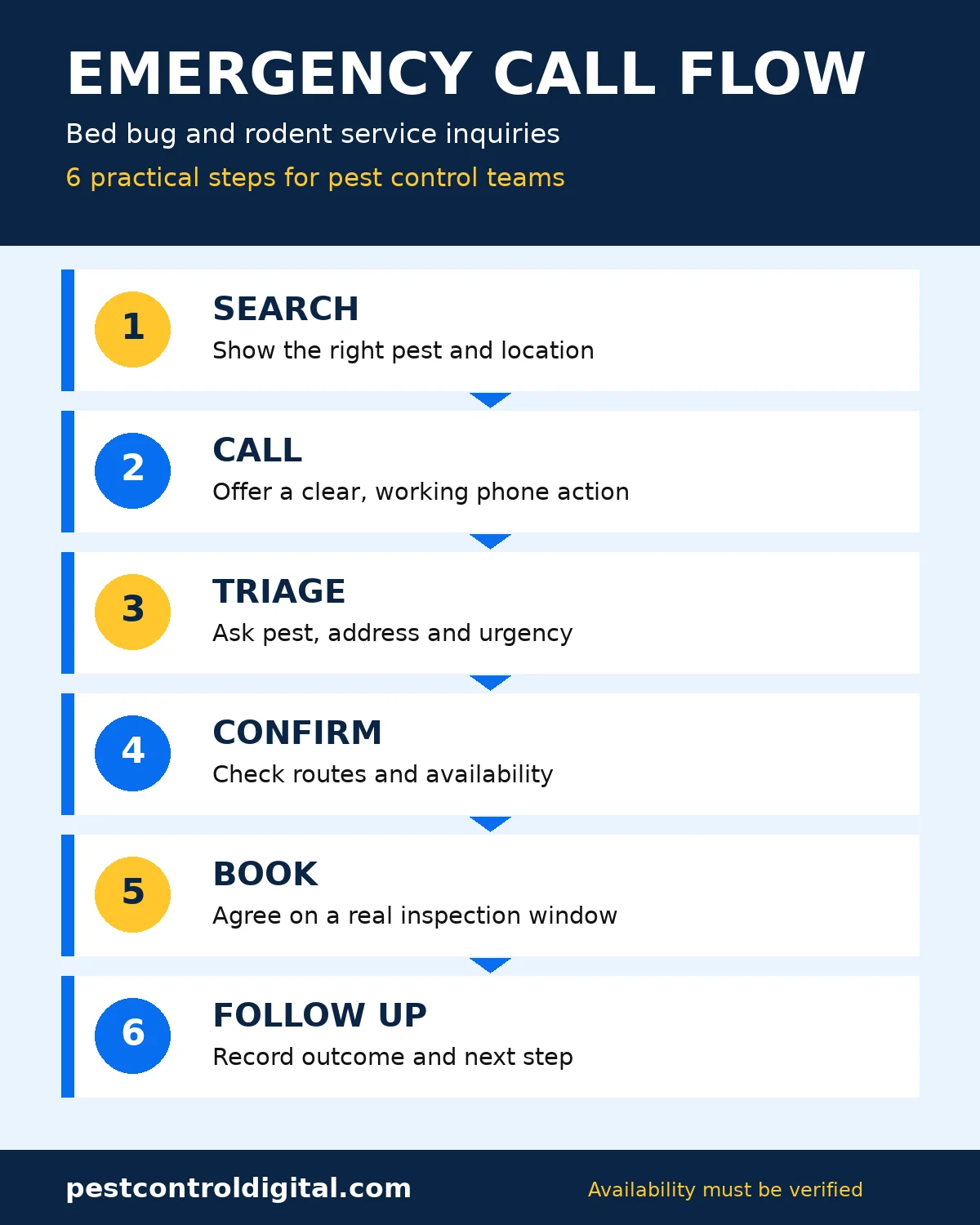
Use a brief intake process. Ask what the caller observed, where the property is located, what type of building is involved, and whether someone can provide access. Photos or a specimen may help the team plan, but a phone description alone should not be treated as a confirmed identification.
Check actual dispatch capacity before offering an appointment. If same-day service is unavailable, provide the earliest real option and explain what the visit covers. If an inspection fee applies, disclose it accurately. Never let advertising copy override what the scheduling system shows.
Track whether the phone was answered, whether the request fit your service area, and whether an appointment was confirmed. Pest control call tracking can support this review when implemented with appropriate privacy and consent controls.
An unanswered phone click is not a booked job. A simple confirmation message with the agreed date, address, and service description can prevent avoidable mistakes. Give staff a clear escalation route when a caller needs information beyond the intake script.
Only advertise same-day service when dispatch has verified a real appointment.
What questions should the intake form collect?
Keep the form short enough for a stressed customer. Collect the contact information and facts needed to determine whether the company can help, rather than requesting an exhaustive account of symptoms or property history. Do not offer a medical diagnosis based on an insect description.
Use the table below as a suggested workflow, not a legal requirement. Confirm that the person has consented to relevant contact and understands when the team will respond. If your team records calls, follow applicable consent rules. A chatbot should not present a tentative appointment as confirmed.
Include a field for preferred contact method only when the team can honor it. Route bed bug and rodent requests to the correct service group and record the outcome. A short form that reaches a real employee is more useful than a complicated form whose notifications are never checked.
| Intake field | Question | Purpose |
|---|---|---|
| Pest concern | What did you observe? | Route to the right service |
| Property location | What is the ZIP or address? | Check service coverage |
| Property type | House, apartment, or business? | Plan access |
| Evidence | Any photos or specimen? | Help prepare inspection |
| Timing | When is access possible? | Verify calendar |
| Next step | Inspection or estimate request? | Record the outcome |
How do paid ads and SEO reach the right customers?
Create distinct destinations for bed bug inspection and rodent control. Searchers use different language, ask different questions, and may require different services. Avoid sending both groups to a broad homepage that offers no immediate answer. Do not make dozens of near-identical city pages simply to repeat a keyword.
Review paid-search terms for unrelated jobs, do-it-yourself research, and places outside the service footprint. Match the landing page to what the advertisement promises, and avoid claiming emergency availability unless the team can provide it. The Google Ads pest control guide covers intent, targeting, and budget decisions.
Organic pages also need accurate coverage, clear headings, useful service details, and working contact options. Link naturally to the pest control SEO guide for a broader strategy. Test page speed and readability on a phone, especially where visitors may be searching under time pressure.
Can automation handle after-hours inquiries?
Automation can acknowledge a message, collect a service address, and route a request to the right inbox. It cannot inspect a home, confirm pest identification, or promise that a technician is already on the way. A truthful message explaining when staff will respond is better than a simulated conversation with invented availability.
Connect any booking bot to real calendar availability and provide a human handoff. Review the system’s replies for accuracy, duplicate messages, and inappropriate advice. An AI chatbot for pest control should help the office manage requests, not replace the qualified employee who makes service decisions.
Measure whether after-hours inquiries become conversations and completed appointments. A message delivered is not a successful booking. Keep the customer’s data limited to what is necessary, and ensure staff can correct an inaccurate response quickly. Do not promise an immediate callback if the team cannot consistently meet that expectation.
Which metrics show whether emergency marketing works?
Track the path from search or advertisement to answered call, qualified request, booked inspection, and completed work. Google distinguishes calls from ads, calls to website numbers, and mobile number clicks in its conversion documentation. A phone-button click is not proof of a connected conversation.
Classify inquiries by pest, location, and disposition. Separate missed calls, out-of-area requests, inspections, and actual jobs. For an illustrative example, ten inquiries might become six conversations, four qualified requests, two inspections, and one completed job. These are made-up planning figures, not industry averages.
Review patterns by service rather than combining bed bug inspections with rodent exclusion projects. Compare the cost of acquiring completed jobs with the economics of the actual work. The lead generation channels guide provides broader context for choosing acquisition sources. Reporting should identify the next operational improvement, not merely display a large call count.
10 inquiries → 6 conversations → 4 qualified requests → 2 inspections → 1 completed job. Replace these figures with actual records.
How Pest Control Digital helps
Pest Control Digital can review your pest-specific pages, advertising relevance, local search presence, call routing, and follow-up process. The goal is to find friction between a genuine inquiry and a properly scheduled inspection. Recommendations should reflect your actual service mix, staffing, and coverage rather than a generic promise of more leads.
Start with a free marketing audit to identify the highest-priority changes before investing in additional traffic. Review the pest control marketing case studies for published examples, or explore the free marketing tools before deciding which changes to prioritize.
Frequently asked questions
Should a company advertise same-day bed bug treatment?
Only if the business can genuinely provide it. Identification and inspection may be necessary before a treatment plan is selected. State the real appointment window, what the visit includes, and whether a separate estimate follows. Do not imply that every infestation can be resolved in one visit.
Do bed bug and rodent services need separate landing pages?
Separate pages are usually useful when the business provides both services because the evidence, inspection questions, and possible work differ. Each page should provide distinct practical information. Avoid simply changing the pest name in otherwise identical content or duplicating city pages without meaningful value.
Can an AI chatbot book urgent pest control visits?
It can collect information and offer available appointments if connected to an accurate booking system. It should not diagnose pests, invent openings, or claim a technician is dispatched before staff confirmation. Provide a human escalation option and check that the appointment is actually recorded.
What should callers do if they find rodent droppings?
Refer them to official CDC cleanup guidance, especially its warning against sweeping or vacuuming droppings before proper disinfection. Do not give improvised hazardous-cleanup instructions. Explain whether the company offers inspection, exclusion, sanitation services, or referrals, and describe the next appropriate appointment step.
How do we measure urgent-call advertising quality?
Track answered calls, qualified requests, booked inspections, completed jobs, and acquisition cost where possible. Record missed calls and out-of-area contacts separately. A click on a phone link does not establish that a conversation occurred, and a long call does not necessarily mean the customer booked service.
Must a bed bug service page display treatment prices?
Only publish prices that the company can substantiate and explain. If the scope depends on inspection, infestation conditions, property type, or treatment method, describe how the estimate is prepared instead. Avoid fabricated flat fees and guarantees that every case will be completed within a fixed number of visits.
Improve your urgent-call conversion path
Request a practical review of your pest pages, phone routing, and booking process.