Pest Control SEO: Complete Guide to More Calls From Google
Pest control SEO helps an exterminator appear for relevant searches, explain services clearly, and convert qualified visitors into phone calls or appointment requests. The best starting point is a usable website, accurate local business information, and service pages that match real customer needs. This guide covers practical priorities, a six-month action plan, and measurement without promising rankings or a specific number of calls.


For a wider comparison, see 12 pest control lead generation channels by cost, speed, and operational control.
For a focused local search workflow, see our guide to ranking a pest control company on Google Maps, including profile eligibility, service areas and review policies.
Key takeaways
- Map keywords to services your crews actually provide.
- Make service pages easy to use on a phone.
- Keep Google Business Profile information accurate.
- Fix indexing and internal-link problems early.
- Measure qualified inquiries and booked jobs.
What does pest control SEO actually do?
For an owner, the most useful SEO question is whether a page helps a real customer take the next step. Review search visibility alongside answered calls, appointment capacity, and the kinds of jobs your technicians can profitably handle in the areas you actually serve.
Pest control SEO helps nearby customers discover an exterminator when they search for a service, compare providers, or need an urgent appointment. It covers the website in organic search and the business information people encounter in local results. Neither channel replaces accurate service areas, a working phone number, or someone who answers inquiries. The goal is not to collect keyword positions. It is to make the right service visible to people you can actually serve, explain the next step, and turn an inquiry into a conversation.
Start with your highest-value services and the locations your crews can reach. Check whether a visitor can find the right page, understand what happens at an inspection, and call without searching through a generic homepage. A rodent exclusion inquiry inside your service area may be more useful than many visits from students researching insects. Google’s SEO guidance emphasizes useful pages and crawlable links; it does not promise first-place rankings.
How do you choose keywords that match real pest control jobs?
For termite specialists, keyword intent changes between swarm identification, inspection requests and treatment comparisons. See the termite company marketing and inspection calendar guide for a service-specific planning example.
Group queries by customer intent. Someone searching for emergency rodent removal has different needs from someone asking how to identify termite damage. A homeowner comparing recurring mosquito programs may want pricing details and scheduling options rather than an urgent phone call. Each important service needs a page that addresses its own questions and next step. A supporting educational guide can answer research questions and point to the relevant service.
Use customer call notes, actual service requests, Search Console queries where available, and your own job records. Keyword tools can suggest language, but estimated volume is not proof of local demand. Do not publish many near-identical pages with only the city name changed. Location content should exist because the business truly serves that area and has useful local information. Prioritize termite inspections, rodent exclusion, mosquito plans, or commercial contracts according to your actual offerings.
| Search intent | Example query theme | Best response |
|---|---|---|
| Urgent | Rodent removal | Response process and phone number |
| Planned | Termite inspection | Inspection steps and booking |
| Recurring | Mosquito plan | Program scope and timing |
| Commercial | Restaurant pest control | Business service capabilities |
| Research | Signs of bed bugs | Useful guide and service link |

What makes a pest control service page useful?
A strong service page quickly answers four questions: which problem do you handle, where do you work, what does the visit involve, and how can someone contact you? Describe inspections, treatment options, preparation steps, and follow-up where relevant. Avoid promising that every infestation can be resolved on the same schedule. Use authentic service information and photos that accurately represent the company. Explain any licenses or qualifications only when they can be verified.
Give each page a descriptive title, a clear heading, and a concise call to action. A termite inspection page might link to prevention information; a rodent exclusion page can explain sealing entry points as well as removal. Make the page usable on a phone. If the number is hard to tap or the form is confusing, visitors may leave even if the page ranks. Pest control website design and content marketing should support the same customer journey. Use this pest control website design checklist to review mobile calls, service pages, and booking forms.
How does Google Maps SEO support organic search?
Google says local results mainly reflect relevance, distance, and prominence. You can improve business information, but you cannot control every searcher’s distance from your company or pay Google for a better local ranking. Verify your Business Profile, choose accurate categories, keep hours current, and use appropriate address or service-area settings. Never invent a storefront or create misleading duplicate listings to cover additional neighborhoods.
Add useful photos, respond respectfully to genuine reviews, and make sure your profile points to a relevant website page. The business name, phone, services, and scheduling process should match across customer-facing channels. A website can explain treatment details that a short profile cannot. Review Google Maps SEO for pest control for implementation options. The AI visibility checker is a separate diagnostic tool, not proof of Google ranking.
Which technical SEO issues deserve attention first?
Keep a record of redirects, canonical URLs, and page changes so later website updates do not undo repairs. Test contact forms after plugin updates. Check that service pages still load correctly for ordinary visitors and that important buttons work on mobile.
Before commissioning more articles, verify that important pages are reachable and eligible for indexing. Check for accidental noindex directives, broken internal links, blocked resources, incorrect canonical tags, redirect loops, and forms that fail on mobile. An XML sitemap helps discovery but does not guarantee that Google will crawl or index a page. The homepage and core service pages should be accessible through normal navigation as well as the sitemap.
Prioritize repairs by business impact. A noindex directive on the termite service page matters more than a missing description on an old announcement. Use Search Console URL Inspection to review Google’s reported state, then test the live page yourself. Record the affected URL, evidence, recommended fix, and owner. A technical SEO audit should produce an actionable repair list rather than a collection of unexplained scores.
Adding pages while an accidental noindex directive prevents the important existing pages from appearing in search results.
What should happen in the first six months of SEO?
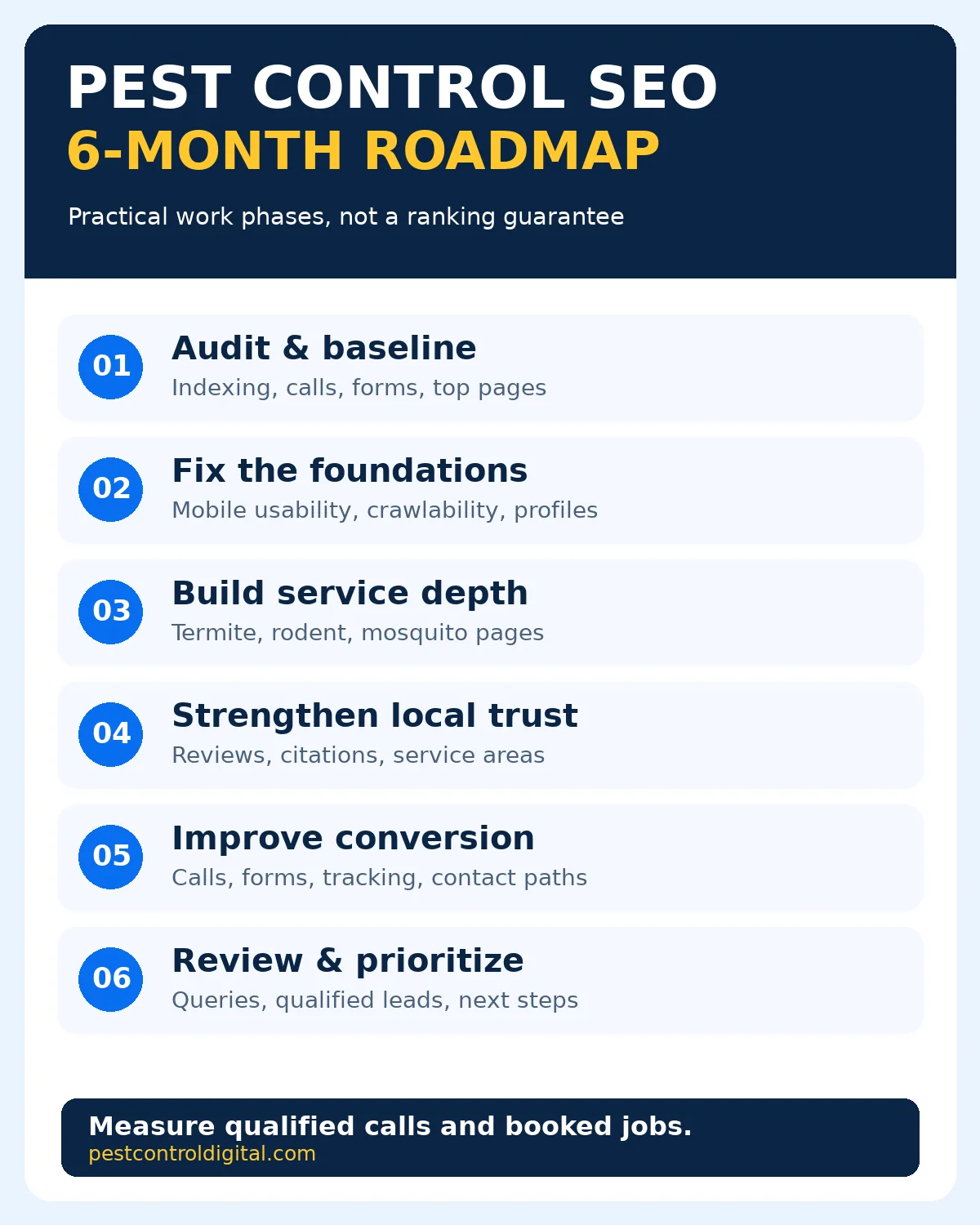
Treat the first six months as a work plan, not a countdown to guaranteed rankings. Establish the baseline, repair important technical problems, improve pages for the services you really sell, and strengthen accurate local information. Later, review search queries, qualified calls, and completed jobs to decide what to refine. If a severe indexing problem appears, fix it immediately instead of waiting for its scheduled month.
Ask for a monthly record of what changed, which pages were affected, and which results were actually measured. Your team may need to supply service photos, confirm coverage areas, approve copy, and handle new inquiries. Without those inputs, even technically sound work can fail to support bookings. The roadmap table below is an illustrative sequence of tasks, not a performance forecast. Use it to assign responsibility and keep work transparent.
| Month | Priority | Deliverable |
|---|---|---|
| 1 | Audit | Indexing, calls, forms, baseline |
| 2 | Foundations | Technical and profile fixes |
| 3 | Service pages | Improve high-value content |
| 4 | Local trust | Reviews, citations, accuracy |
| 5 | Conversion | Contact paths and tracking |
| 6 | Review | Qualified leads and next actions |
These are suggested work phases, not guaranteed ranking milestones.
How do reviews and local trust influence customer decisions?
Reviews help homeowners evaluate whom to invite onto their property. Google also identifies reviews and broader prominence signals in its local ranking explanation. That does not justify buying reviews, selectively asking only happy customers, or inventing testimonials. Build a consistent request process after legitimate service interactions and encourage honest feedback. Respond professionally without exposing customer addresses, treatment details, or private information.
Trust also comes from accurate contact details, service descriptions, operating hours, and a clear explanation of what happens next. Commercial customers may need documented service capabilities or a written scope rather than a public review request. If your company holds relevant licenses or qualifications, present them precisely. Avoid unsupported response-time promises or claims about pest elimination. These practices help customers assess the provider even when rankings do not change.
How should you measure SEO calls and booked jobs?
Search Console shows Google Search impressions, clicks, queries, and landing pages. Website analytics show what visitors do after arriving. Your phone system or CRM should answer a different question: was the inquiry relevant, answered, quoted, booked, and completed? These systems use different definitions, so their numbers will not always match. Do not describe an impression, a click, or a long phone call as a confirmed job.
Define a qualified lead before reporting begins. The person should be in an active service area and ask about work the company provides. Track missed calls separately from answered conversations and segment performance by service when possible. A page with modest traffic that produces termite inspections may matter more than a popular informational article. Respect privacy and consent requirements when recording calls or storing customer data. Compare trends over time instead of celebrating a single ranking snapshot.
What can the Orlando pest control SEO case study prove?
For fair comparisons, use consistent definitions for organic visits, qualified inquiries, and booked jobs. Note seasonal shifts, advertising activity, changes in service capacity, and expanded coverage areas before attributing every increase or decline to search optimization.
Pest Control Digital’s Orlando pest control SEO case study reports 945K Google impressions and 5.83K organic clicks. These are figures reported for that particular project. They are not industry averages, expected results for another company, or evidence that a particular number of jobs was booked. Impressions measure appearances in search results, while clicks measure visits from those results.
Before using any case study to set expectations, ask about its measurement period, starting visibility, service area, competition, and work performed. An operator selling seasonal mosquito programs needs different lead and booking measures from a commercial termite specialist. A useful case study should prompt questions about implementation and measurement, not replace an audit of your own business. Treat claims that lack context as illustrative rather than predictive.
How Pest Control Digital helps
Pest Control Digital reviews website structure, search visibility, local business information, service content, and conversion paths for pest control companies. The first recommendation might be a technical repair, clearer service page, better call tracking, or focused local SEO work rather than an expensive rebuild. Each proposal should connect deliverables to the services and locations the company actually supports.
Explore pest control SEO services or request a free growth audit. We do not guarantee a ranking, a specific lead volume, or revenue. The objective is transparent, measurable work that supports qualified customer inquiries.
Comparing organic search with paid acquisition? Our Google Ads for pest control guide explains budgeting, search intent and qualified call tracking.
Frequently asked questions
How long does pest control SEO take?
There is no fixed timetable. Google notes that changes can take hours to months to appear, and not every change improves visibility. Review completed work and business outcomes regularly instead of relying on a promised ranking date.
Should termite, mosquito, and rodent services have separate pages?
Separate pages are useful when services have different customer questions, treatment processes, and search intent. Only create pages for services the business genuinely offers. Avoid duplicating nearly identical text across multiple URLs.
Can a service-area company appear on Google Maps?
Eligible service-area businesses can maintain a Business Profile when they follow Google’s guidelines. Use accurate service-area settings and avoid displaying an address customers cannot visit. Eligibility does not guarantee a specific local ranking.
Is SEO better than Google Ads?
The answer depends on existing visibility, crew availability, website quality, and budget. Paid ads and organic search serve different purposes. Repair broken contact paths and measurement before expanding either channel.
Will adding more keywords improve my ranking?
Not by itself. Keywords help match intent to pages, but useful information, crawlability, local business accuracy, and competition matter too. Excessive repetition makes a page less helpful to readers.
What belongs in a monthly SEO report?
Request completed tasks, important technical fixes, relevant search queries and pages, qualified inquiries, bookings where available, and next priorities. Ask the provider to explain data gaps and avoid equating impressions with revenue.
For a separate look at AI-assisted discovery, see our pest control AI search visibility guide, including crawler access, local trust signals, and qualified-call measurement.
Find your next SEO priority
Get a practical review of your website, local visibility and inquiry process.