How to Rank a Pest Control Company on Google Maps
Pest control Google Maps ranking depends mainly on how relevant your business is to a search, how close it is to the searcher, and how prominent it appears online. You can improve your Google Business Profile, website, authentic customer reviews, and customer experience, but you cannot buy a guaranteed position. This guide explains the practical steps a pest control owner can control.

Key takeaways
- Local results depend mainly on relevance, distance, and prominence.
- Eligibility and accurate service-area details come before optimization.
- Genuine reviews and useful service pages help customers choose.
- Measure qualified calls and bookings, not just map positions.
- There is no guaranteed or paid organic Maps placement.
How pest control Google Maps ranking actually works
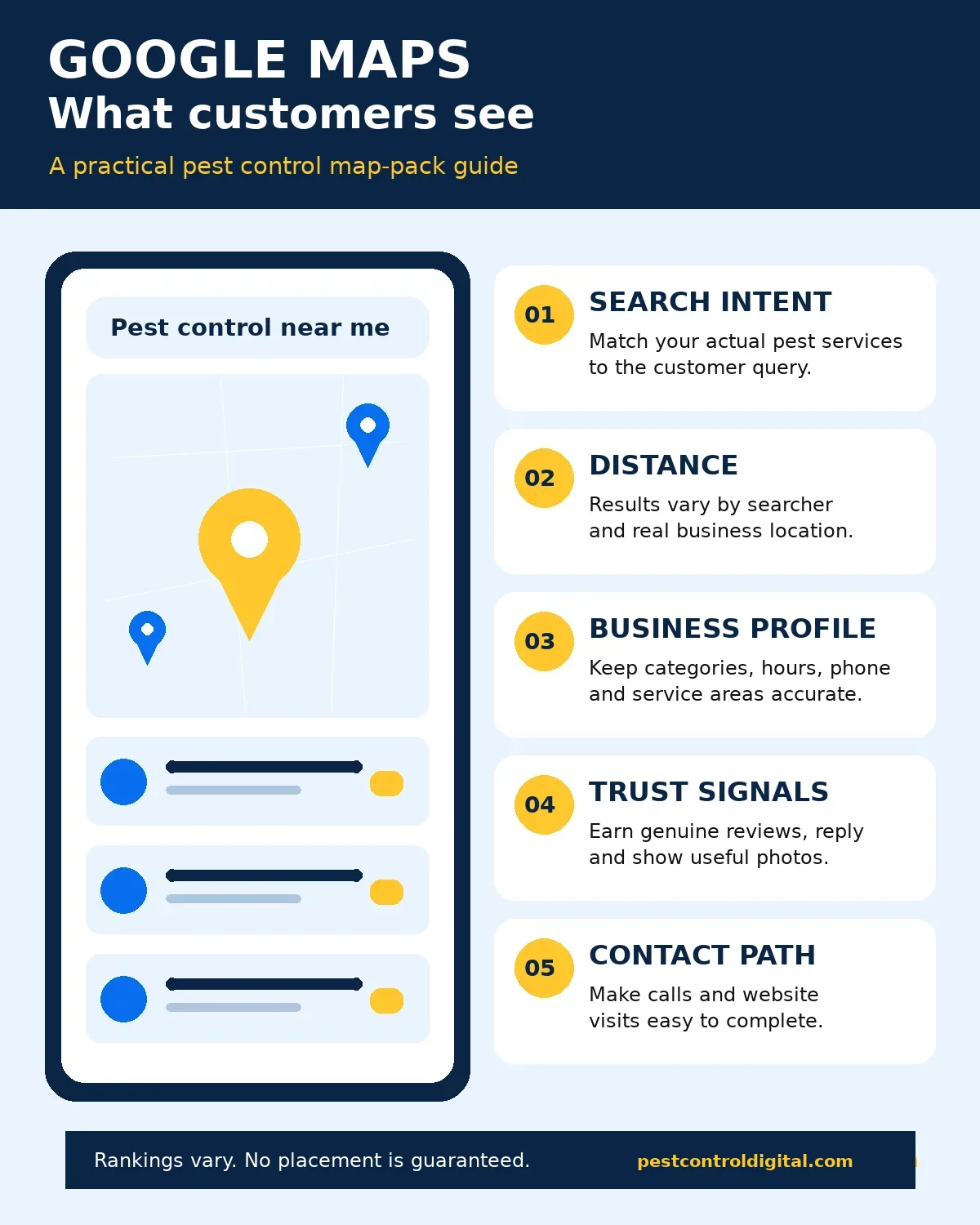
Google says local results are mainly based on relevance, distance, and prominence. Relevance asks whether a profile matches the search. Distance considers where the searcher is relative to a business. Prominence considers how well-known the business is, including signals such as links and reviews. These are broad principles, not a published formula or a checklist that guarantees the top three results. The same exterminator may appear for “termite inspection near me” but not “mosquito treatment,” or may appear in one neighborhood but not another. That does not necessarily mean the profile is broken.
Start by separating what you can control from what you cannot. You can accurately describe your services, select appropriate categories, keep contact details current, publish useful pages, and ask customers for honest reviews. You cannot move the searcher’s location, dictate competitors’ activity, or purchase an organic Maps position. Google explicitly says there is no way to request or pay for better local ranking. Treat any agency claiming a permanent number-one position as a warning sign. Your goal is a trustworthy profile that matches actual services and makes it easy for suitable customers to contact you.
| Element | What Google describes | Practical owner action |
|---|---|---|
| Relevance | Accurate categories, services, and website content | Complete genuine business details |
| Distance | Searcher and real business location | Serve realistic areas; do not create fake offices |
| Prominence | Reviews, links, broader business recognition | Earn authentic feedback and useful mentions |
| Conversion path | Not an official ranking factor | Make calls and service pages easy to use |
Check whether your pest control profile is eligible
Before optimizing, confirm that your Google Business Profile represents a genuine operating business. Many pest control companies travel to customers and do not receive visitors at their dispatch address. Google calls these service-area businesses. If customers do not visit your address, the address should be hidden on the public profile. A hybrid business that genuinely receives customers at a staffed, signed location may show its address and specify its service area. A mailbox, unstaffed virtual office, or fabricated branch is not a valid shortcut to another map listing.
Google’s rules generally allow one profile for the area served from a central operation. Separate profiles may be appropriate for genuine staffed locations with distinct teams and service areas, not for each suburb you want to target. Check the real-world business name as well: adding “Best Termite Control Miami” to a name that is actually “Smith Pest Services” is not compliant optimization. Use your actual business name, verify ownership, and correct duplicate or unauthorized listings before investing in new posts or citations. The official Business Profile guidelines are the rulebook; they matter more than a generic SEO checklist.
Complete the profile fields that help customers choose
Select the most accurate primary business category available, then add only relevant secondary categories. List services you genuinely perform: termite inspections, mosquito treatments, rodent exclusion, bed bug work, or recurring general pest plans as appropriate. Do not claim a license, treatment method, guarantee, or coverage area your operation cannot substantiate. Keep hours accurate, including holiday exceptions, and use a phone number that reaches your business. A missed emergency call can erase the value of a good listing.
For service areas, Google allows up to 20 named areas such as cities or postal codes. It advises that the overall area generally should not extend farther than about two hours’ driving time from the base, though exceptions can apply. These settings describe where you serve; adding more cities does not automatically make you rank in each one. Choose real dispatch areas and verify that the website’s service information agrees. Use recent, genuine photographs of technicians, vehicles, equipment, and jobs when appropriate, without exposing customer addresses or private details. Review Google Maps SEO for pest control if you need help organizing this work.
Connect Maps visibility to useful pest-control pages
Your profile should lead to a website that answers the visitor’s next question. Someone searching for termite inspection needs to know whether you offer inspections, which communities you cover, how scheduling works, and how to contact the team. Someone searching for emergency rodent removal needs a clear service explanation and an honest statement of availability. Sending every visitor to a generic homepage can make them hunt for basic information. A focused service page is useful when it represents a real service with distinct customer needs.
Build a clear structure: one helpful core page for each meaningful pest category, a service-area explanation, and a straightforward contact route. Avoid cloning dozens of city pages with only the place name changed. Use descriptive titles, natural local references, mobile-friendly text, and accessible tap-to-call buttons. Keep phone numbers and business details consistent. Google Search Central’s LocalBusiness structured data documentation explains how to provide machine-readable details, but markup is not a shortcut to a Maps position. Our schema markup checklist for pest control websites explains which business details to verify before adding structured data. If the website has technical problems, a pest control SEO review can identify what blocks useful pages from being discovered or used.
Build trust with real reviews, photos, and citations
Google states that more reviews and positive ratings can help local ranking, while useful review responses help customers assess a business. Ask customers who actually received a service to leave an honest review through your Google review link or QR code. Never offer a discount, gift, or free treatment in exchange for a review, and do not screen out unhappy customers. Google’s review guidance prohibits incentivized and misleading reviews. A genuine mixed review history is more credible than a sudden batch of scripted five-star claims.
Reply professionally, without disclosing customer addresses, pest details, or private conversations. Add photographs that show real operations and safe, professional service practices. For citations, prioritize accurate listings on legitimate directories and industry resources rather than buying hundreds of low-quality submissions. Correct an old phone number or business name before expanding to new sites. The purpose of citation management is consistent discoverability and customer confidence, not a magic ranking multiplier. A practical review and reputation process should be repeatable by your office team after every completed job.
Do not add keywords to your real business name, use a fake office, or exchange incentives for Google reviews. These tactics can violate Google’s policies.
Understand the map-pack journey before chasing positions
A local search result is more than a blue pin. A customer sees a business name, category, location context, review information, operating details, and actions such as calling or opening the website. Each element creates a chance to confirm or reject the business. A homeowner with a termite concern may compare the business category and reviews first; a property manager may open the website to check commercial coverage. Neither customer benefits from inflated claims or a disconnected phone line.
Use a simple diagnostic: search for a real service from the neighborhoods your crews can actually reach, inspect what the result communicates, then test the contact path. Does the call button reach a person or voicemail? Does the linked page clearly match the pest problem? Is the opening-hours information accurate? Can someone request an inspection without completing a long form? Do not use a single manual search as a reliable ranking report because results vary with location and context. For a separate perspective on emerging discovery channels, the AI visibility checker is available, but AI search visibility and Google Maps ranking are not the same metric.
Measure qualified calls, not just profile views
Google Business Profile Performance can show searches, views, call-button clicks, website clicks, and other available interactions for verified profiles. A call-button click is not proof that a person connected with your team, qualified for service, or booked a job. Google notes that the available metrics vary by business, and the searches report may update after the start of a month. Use these figures to identify patterns, then reconcile them with your phone and scheduling records. If the profile shows activity but the office records few bookings, the issue may be call handling or lead quality rather than ranking alone.
Track a small set of operational outcomes: answered calls, qualified pest inquiries, inspections scheduled, jobs completed, and the location and service requested. Use privacy-conscious tracking and avoid changing the public business phone to a number you cannot control. Compare performance by real service area, not a single statewide average. An illustrative dispatch worksheet can label zones as core route, occasional route, and outside coverage. Do not interpret these labels as a Google ranking model. If your office needs better attribution, review call tracking for pest control and define the business outcomes before installing tools.
Follow a practical 30-day Maps improvement plan
A month is enough to complete an organized baseline and many corrective tasks; it is not a promise of ranking improvement. In the first week, confirm profile ownership, eligibility, category, name, hours, phone, and service area. In the next week, inspect the website’s highest-demand service pages, repair broken links or mobile contact buttons, and make sure the profile points to a useful destination. During the third week, create a consistent process to ask every eligible customer for honest feedback and respond to existing reviews. In the fourth week, review profile performance alongside real calls and booked work, then document unresolved issues for the next cycle.
Use the table below as a task register. Assign an owner and an evidence field for each task rather than simply checking a box. The office manager may own calls and hours; the field team can provide legitimate photos; the marketing specialist can handle page quality and reporting. When a task is complete, capture what changed and when. If your company already has a strong profile, spend more time on the weakest part of the customer journey instead of making unnecessary edits. For additional context, see the pest control SEO guide and compare broader organic search with local profile performance.
| Timing | Work to complete | Evidence to keep |
|---|---|---|
| Week 1 | Eligibility, ownership, category, hours, service area | Screenshot and corrections log |
| Week 2 | Service pages, phone links, mobile contact path | Working links and page checks |
| Week 3 | Honest review requests and replies | Approved review workflow |
| Week 4 | Profile metrics matched with actual bookings | Qualified lead and job summary |
How Pest Control Digital helps
Pest Control Digital can review profile eligibility, categories, service-area accuracy, website relevance, customer contact paths, and measurement before recommending work. The review should distinguish policy compliance from ranking opportunities and prioritize changes your company can verify. A map listing is useful only when the business can serve the customer who finds it. Explore the Google Maps SEO service or request a free pest control growth audit for a scoped action plan. We do not guarantee a map-pack position, lead count, or revenue outcome.
For a field-by-field review, follow our 30-point pest control Google Business Profile checklist before making profile changes.
Frequently asked questions
Can I pay Google to rank first in Maps?
No. Google states that you cannot request or pay for a better organic local ranking. Paid advertising is a separate product and does not guarantee an organic Maps position.
Will adding more service-area cities improve rankings?
Not automatically. Service areas should reflect where you actually operate. Google allows up to 20 named areas, but distance and other local ranking factors still apply.
Should a home-based pest control company display its address?
If customers do not visit the business address, Google says to hide it and configure the profile as a service-area business. Follow the current eligibility rules.
Do five-star reviews guarantee a top-three listing?
No. Genuine reviews can support customer trust and may help prominence, but distance, relevance, and other signals also matter. Never purchase or incentivize reviews.
How often should I update my Google Business Profile?
Update it when important business facts change, including hours, services, contact information, or service areas. Add authentic photos and respond to reviews as part of normal operations.
Why do I see my business in one neighborhood but not another?
Local results change with searcher location, query intent, competition, and other factors. Compare several real service areas, then focus on profile accuracy and customer outcomes.
Want a clearer local search plan?
Get a practical review of your Google Maps presence, website, and qualified inquiry path.
Sources
Google’s official documentation was reviewed on November 2, 2026. These are policy and product references, not claims that any particular tactic guarantees ranking.