llms.txt and Schema for Pest Control Websites: What Actually Helps
Pest control schema markup helps search systems understand your business details, services, and published content. An llms.txt file is a different tool: a proposed guide to selected pages for some AI readers. Neither guarantees rankings or recommendations. For a pest control owner, accurate pages, sensible structured data, and working contact information deserve attention before experimental AI files.

Key takeaways
- Google says llms.txt is not required or specially used for its Search or generative AI features.
- Use structured data to describe facts already visible to customers, not to invent business attributes.
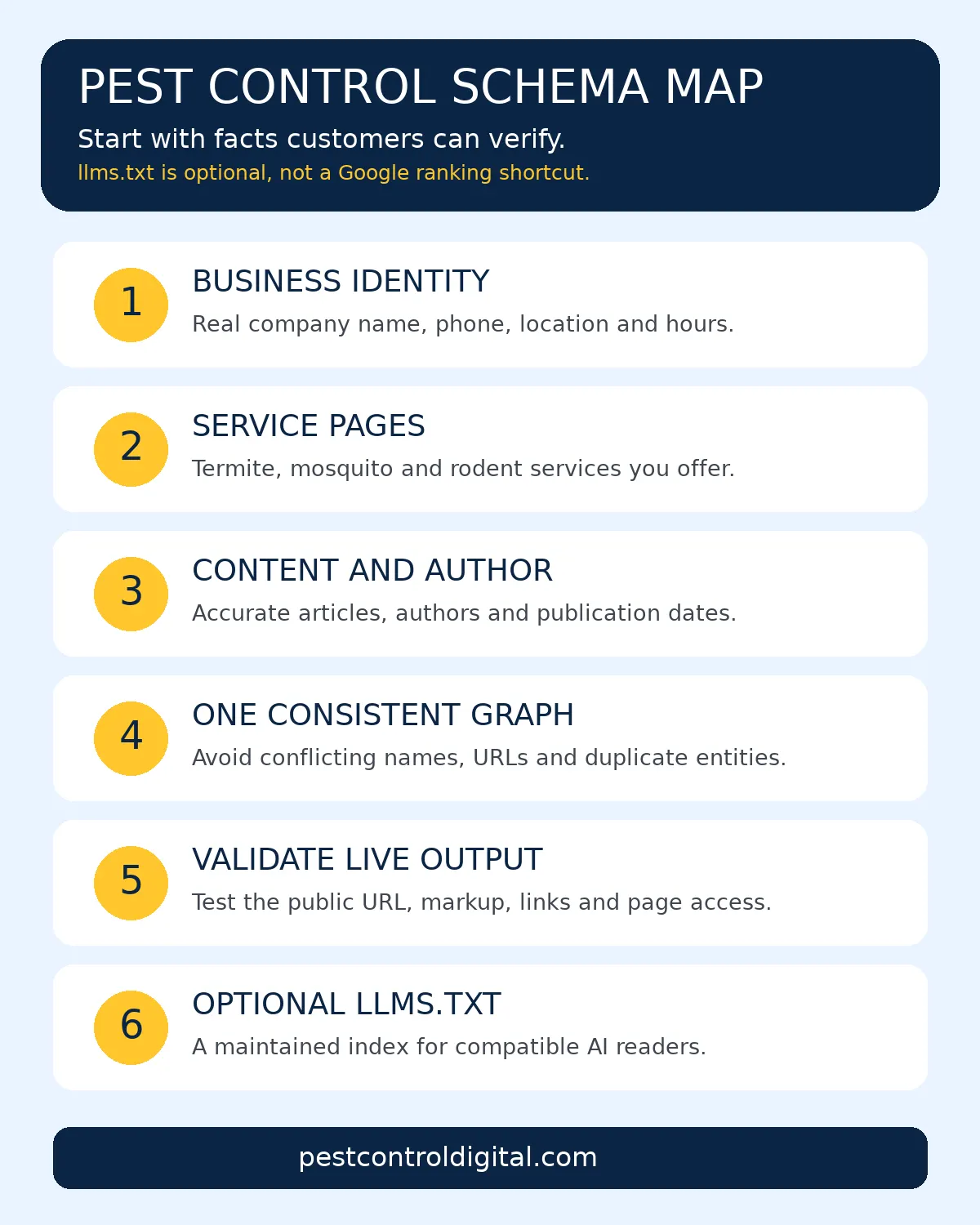
- Start with your business identity, real service locations, service pages, and article authorship.
- Check what your WordPress SEO plugin already outputs before adding another schema generator.
- Validate the rendered page, not just the JSON-LD pasted into an editor.
What actually helps a pest control website?
Start with the information a homeowner needs to decide whether to contact you: the pests you handle, the areas you serve, how inspections work, your operating hours, and a reliable phone or request form. A structured data script cannot repair an empty termite page or a disconnected call button. It can, however, make accurate business details easier for compatible systems to interpret.
Google’s generative AI search guidance says its AI features use established Search systems. It specifically says special AI files and markup are not needed for inclusion. That is a useful filter when a vendor promises an AI shortcut.
For a company offering residential pest control in Orlando, the practical foundation is a clear service page that explains inspections, treatments, follow-up expectations, and genuine coverage. Add consistent company identity and correct technical markup. Then check whether search visitors can actually reach the office.
Does an llms.txt file improve Google AI visibility?
No special Google Search benefit has been established. Google explicitly states that its Search systems, including generative AI features, do not use llms.txt as a special input. Publishing one does not replace indexing, useful content, internal links, or a maintained Google Business Profile.
The llms.txt proposal describes a human-readable Markdown index of selected resources. Its August 2026 revision also discusses links that help compatible agents discover Markdown versions. This is an evolving convention, not a universal search ranking standard.
That distinction matters for owners comparing technical SEO proposals. An llms.txt file can be a modest documentation or accessibility experiment when a particular agent supports it. It should not consume the budget needed to fix broken service pages, inaccurate contact details, or pages blocked from indexing.
If you want to experiment, select real URLs such as your termite inspections, mosquito programs, and service-area information. Keep descriptions neutral, update them when services change, and verify every link. The llms.txt generator can help prepare a draft, but review the result rather than assuming automated output is authoritative.
A practical llms.txt maintenance process is simple. Assign someone to check the file whenever the service menu, main contact details, or important landing pages change. Remove redirects and retired URLs, and make sure descriptions still match what a customer would find after clicking. Do not put pricing promises, internal documents, or customer information into a public file. If a tool cannot demonstrate that it actually reads llms.txt, treat its proposed benefits as unverified rather than building a reporting dashboard around them.
Which schema types belong on a pest control site?
Think of schema as a map of existing information, not a separate advertising channel. A pest control company may use a suitable LocalBusiness subtype for a real business location, Organization information for company identity, Service descriptions for actual offerings, and BlogPosting for educational articles. BreadcrumbList can explain the site’s navigation structure.
Google documents specific supported rich-result features. Some schema.org vocabulary is useful for machine interpretation without creating a special Google result. In particular, adding Service markup does not promise a service carousel or a higher Maps position. Match each type to the page’s real purpose.
Most WordPress SEO plugins already create a connected graph for WebSite, WebPage, Organization or Person, and Article. Adding a second independent graph without checking the first can produce conflicting names, URLs, or authors. Inspect the live source before installing another schema plugin.
Which pest control schema fields should owners verify?
Google’s LocalBusiness documentation explains how business information can be represented. It distinguishes required and recommended properties for eligible features. For service-area operators, do not publish a fictional storefront address merely to fill a field. Confirm the appropriate business representation and profile settings first.
| Field or property | What to verify | Pest-control example |
|---|---|---|
| name and url | Public trading name and canonical website | Match the actual company and domain |
| telephone | Number answered by the correct office | Route termite inquiries to the real team |
| address | Real eligible location, where applicable | Never invent a city office |
| areaServed | Areas genuinely covered | Only counties your crews can serve |
| openingHoursSpecification | Actual published operating hours | Separate office hours from emergency availability |
| sameAs | Official profiles controlled by the company | Real business social profiles |
| image and logo | Accessible, current brand assets | Real truck or company logo image |
| author and datePublished | Correct article contributor and date | Named pest-control educator or editor |
| serviceType | Service genuinely described on the page | Termite inspection, not an unoffered guarantee |
This is an editorial field checklist, not a claim that every field is required by Google. Some are schema.org properties, some apply only to particular types, and eligibility rules vary. If a field is unknown, investigate it instead of inserting placeholder values. The pest control schema generator can help structure confirmed information.
Service-area businesses need an extra review. Some pest operators have a legitimate office, while others dispatch technicians from a private base and do not receive customers there. The website, Business Profile, and structured data should not contradict one another. Keep an internal record of which address is public, which phone number is customer-facing, and which counties or ZIP codes the team can reliably serve. If a company expands into a new market, verify staffing and coverage before changing the schema or launching a location page.
How should termite, mosquito, and rodent pages use markup?
A termite inspection page should first explain what the customer can request, which property types are covered, what an inspection includes, and how scheduling works. A mosquito program page may need seasonal availability, visit frequency, and service boundaries. A rodent page should distinguish inspection, trapping, exclusion, and cleanup when those services are genuinely offered.
Schema can reflect these differences, but it cannot create them. For example, a Service entity may describe a termite inspection, link to its provider, and identify an accurate service area. That is more defensible than adding dozens of unverified pest and city combinations to one giant JSON-LD block.
Keep the visible text, structured data, and customer intake aligned. If a service page says only inspections are offered, do not mark up a guaranteed eradication package. If the company does not take calls overnight, do not describe the office as open around the clock.
Use the technical SEO service guide for the wider crawlability and template checks, and the pest control SEO guide for how individual service pages fit into the site architecture.
For a multi-service company, keep one documented source of truth. The office manager may own hours and contact details, operations may own service coverage, and the content team may own page descriptions. Have each owner approve changes that affect their area. This prevents a marketing contractor from labeling a mosquito-only program as comprehensive outdoor pest treatment, or copying termite warranty language into a service that does not offer one. Accurate operational details are more valuable than an elaborate schema graph filled with assumptions.
What schema and llms.txt mistakes create avoidable risk?
One common error is duplicate business identity. The theme may output Organization markup while a plugin outputs a second business with a different phone number. Another is outdated office information after a move or territory change. A third is adding review stars to the company’s own LocalBusiness markup and expecting Google to display them.
Google’s structured data policies require markup to represent the page honestly and to be accessible to crawlers. The general structured data guidelines also state that correct markup does not guarantee a rich result. Avoid fake ratings, nonexistent locations, invented prices, and claims that customers cannot verify.
For llms.txt, avoid copying a sitemap wholesale, publishing private operational documents, or linking to old pages. A file that sends an agent to a removed bed bug service is less useful than a short, maintained index. Treat it as a supplement, not a replacement for HTML navigation or an XML sitemap.
How do you validate schema before calling the work complete?
Begin with the public URL, not the editor preview. Confirm that the page returns a successful response, is not unintentionally marked noindex, and has a consistent canonical URL. View the rendered HTML and locate each JSON-LD script. Compare the business name, phone, address, author, and linked pages with what customers can see.
Use Google’s Rich Results Test for supported rich-result types, then use Search Console URL Inspection to understand Google’s view of the page. The schema.org validator can also help inspect vocabulary that does not correspond to a Google rich-result feature. Passing a syntax test is only the first step: factual accuracy still needs a human review.
Test a sample of service templates, not only the homepage. A multi-location pest company should check a real location page, a termite service page, an article, and the contact page. After a plugin update or redesign, retest because templates can change output without warning.
Finally, click the actual phone number and form. A valid LocalBusiness graph is not useful if a qualified homeowner cannot reach you. The pest control landing-page guide explains the conversion checks that belong beside technical validation.
Keep a short evidence log for each validation run: the URL checked, the date, the business fields inspected, any warnings, and the person who approved the correction. Separate a syntax warning from a factual mismatch. A missing optional property may be low priority, while a wrong phone number or a canonical pointing to another market can interrupt real inquiries. When a template change fixes several pages, retest a representative sample and confirm that the fix did not alter unrelated service or location content.
What should you prioritize with a limited technical budget?
Use a sequence that protects real customer access first. Fix crawlability, broken pages, canonical errors, and wrong contact information before polishing optional markup. Next, confirm that your SEO plugin generates a coherent business and article graph. Then fill missing factual fields on high-value pages and test them.
| Work item | Priority | Reason for an owner |
|---|---|---|
| Accessible service pages and correct contacts | First | Customers and crawlers need usable information |
| Indexing, canonical and XML sitemap checks | First | Prevent avoidable discovery problems |
| Accurate business identity and article schema | Next | Describe verified entities consistently |
| Service-specific fields and template validation | Next | Reduce confusion across different pest services |
| Optional llms.txt maintenance | Later | Experimental value depends on the reader using it |
This is a practical priority framework, not a ranking-factor scorecard. An owner with a small service area and a handful of pages may finish the essential audit quickly. A franchise with many territories needs stronger template controls, location ownership rules, and regular checks for conflicting business data.
Measure outcomes with Search Console impressions, relevant landing-page visits, qualified calls, and booked inspections. The earlier AI search visibility guide explains why a citation or mention should not be confused with a customer. The Google Business Profile checklist covers the separate local listing work.
Consider a simple owner review at the end of each quarter. Open the highest-value service pages on a phone, verify the call button, read the stated service area, and compare it with dispatch reality. Then check the structured data output and the current business profile. This takes attention away from speculative AI visibility scores and toward mistakes that can be corrected. Record what changed and monitor qualified inquiries afterward, without assuming that one technical edit caused every movement in search traffic.
How Pest Control Digital helps
We review the pages customers actually use, inspect existing structured data, and prioritize errors by business impact. That can include conflicting business information, missing service details, inaccessible pages, or a schema generator producing values that the company cannot substantiate.
Our technical SEO for pest control companies service focuses on fixes that make a site easier to crawl, understand, and use. The next step is a scoped review of your current pages, not a promise of AI recommendations or special rich results.
Frequently asked questions
Is llms.txt required for pest control AI search?
No. Google says its Search and generative AI features do not require or specially use llms.txt. The file is an evolving proposal that may help compatible tools navigate selected resources. Publish it only when you can maintain accurate links, and prioritize accessible service pages and correct business details first.
Will LocalBusiness schema improve my Google Maps ranking?
Schema can communicate factual business information to compatible search systems, but Google does not promise a Maps ranking improvement from adding it. A complete, accurate Business Profile and genuinely useful local service pages still matter. Evaluate visibility and customer contacts over time rather than expecting a schema installation to change positions immediately.
Should every pest service page have its own schema?
Each page should carry markup that fits its actual content and template. A termite inspection page and a mosquito maintenance page may have different Service descriptions, while the same business identity can be referenced consistently. Avoid cloning conflicting LocalBusiness objects across pages or claiming services your team does not provide.
Can I add five-star ratings to my pest control schema?
Do not invent ratings or assume self-serving reviews will produce Google review stars. Google’s review-snippet rules restrict LocalBusiness and Organization pages when the reviewed business controls the reviews. Genuine testimonials can still help customers, but the visible content and any markup must follow the applicable policies.
Does valid schema guarantee a rich result or AI recommendation?
No. Passing a validator means the markup meets certain technical checks, not that Google will display a rich result or an AI system will cite your page. Search systems also assess page eligibility, relevance, quality, and other factors. Use testing to find errors, not as a forecast of traffic.
How often should a pest control company audit its markup?
Review markup after a website redesign, SEO plugin change, new location, phone update, or major service change. Periodically sample the homepage, core service pages, and articles for mismatched facts. Keep an owner-approved source of truth for names, numbers, hours, and coverage so multiple plugins do not drift apart.
Want a practical technical SEO review?
Find out whether your pest control website has crawl, schema, or conversion issues worth fixing first.
Sources and further reading
- Google Search Central: Generative AI search guidance (reviewed November 2, 2026).
- Google Search Central: LocalBusiness structured data (reviewed November 2, 2026).
- Google Search Central: Structured data guidelines (reviewed November 2, 2026).
- llms.txt proposal and specification (reviewed November 2, 2026).