How to Get More Google Reviews for a Pest Control Company, the Right Way
Pest control reviews grow when every real customer receives a simple, neutral invitation after service, not when technicians chase five-star ratings. Give customers the correct Google review link, make requests consistent across termite, mosquito, and general pest visits, and respond professionally to feedback. The goal is trustworthy evidence of real experiences that helps homeowners make an informed choice.


Key takeaways
- Request honest Google reviews from all eligible customers, not only happy ones.
- Trigger requests from completed service records rather than a technician’s guess about satisfaction.
- Use Google’s official review link or QR code; never offer rewards for a review.
- Respond without exposing private treatment, address, or billing information.
- Measure invitations and responses, but judge the program by service quality and trust.
Why do pest control reviews matter before the phone rings?
A homeowner looking for rodent exclusion or a termite inspection may compare several companies before making a call. Reviews help them understand how a crew communicates, arrives, explains treatment options, and handles follow-up visits. These details can matter more than an isolated claim about being the best exterminator in town.
Google states that more reviews and positive ratings can help a business’s local ranking, but relevance and distance also influence results. A strong review profile does not guarantee a Maps position. Your Google Maps ranking strategy still needs an accurate business profile, relevant services, and a useful website.
For pest control, the quality of feedback matters because the work is not always visually obvious. A customer may not know whether a treatment has worked immediately, but they can describe whether the technician arrived, explained the next steps, respected the property, and gave realistic expectations.
Build a pest control reviews process around completed work
The most reliable system begins in the service schedule or customer relationship management system (CRM). Mark an appointment completed only when the agreed visit actually happened. Then send the same optional, neutral review invitation to the customer using a communication channel they have agreed to receive.
Do not make the request depend on a technician selecting “happy customer.” That creates review gating: disappointed customers are quietly excluded while satisfied customers get the link. Google’s Maps policy explicitly prohibits selectively soliciting positive reviews or discouraging negative ones.
For a recurring quarterly service, ask after a real visit rather than repeatedly after every automated invoice. For a new termite inspection, ask about the inspection experience once the customer has received the findings. For rodent exclusion, distinguish an inspection from the completion of sealing work so the invitation does not imply the entire problem is resolved.
Give the office team a separate path for service complaints, missed appointments, and billing questions. That path should be available to every customer whether they review the company or not. Review requests must never be conditional on using a complaint form first.
Choose review request timing by service type
There is no universal hour or day that Google prescribes for requesting a review. The right moment is when the customer can fairly describe the service received. Use your actual appointment milestones, customer contact preferences, and follow-up obligations instead of copying a generic “send after two hours” automation.
| Service situation | Practical request point | What to check first |
|---|---|---|
| One-time general pest visit | After the completed visit and service summary | Customer received the agreed service |
| Termite inspection | After findings and next steps are delivered | Do not imply treatment success |
| Rodent inspection or exclusion | After the specific completed stage | Identify what work remains |
| Recurring mosquito service | After a real visit, not each invoice | Avoid excessive repeat requests |
| Commercial pest management | After an authorized contact can assess service | Use the correct decision-maker |
This is an operational decision table, not a ranking study or a claimed response-rate benchmark. Teams should adjust it to their actual service agreements and ask frequency. Never delay a review link only because a customer has complained.
Make the Google review link easy to use
Open your verified Google Business Profile, select the reviews area, and use Google’s “Get more reviews” option to copy the link. Google also offers a QR code generated from a desktop browser. Test the destination yourself before adding it to an email, invoice, service summary, or customer message.
A request can be simple: “Thank you for choosing our team for your recent pest control visit. If you would like to share an honest review of your experience, here is our Google review link. All feedback is welcome.” Avoid asking for five stars, specific keywords, a technician’s name, or a particular description.
Use the same request language across customer groups. Personalize the greeting and service reference, but do not ask the customer to include the words “termite treatment in Orlando” or other SEO phrases. Google forbids merchants from pressuring people to include specified content in reviews.
Test the link on a phone and confirm that it points to the correct location when you operate more than one verified profile. Customers should not have to search through several listings or guess which branch handled their visit. See the Google Business Profile optimization checklist for other profile accuracy checks.
Give technicians and office staff distinct responsibilities
Technicians should concentrate on completing the visit, explaining the service report, and recording accurate next steps. They can mention that the office may invite honest feedback, but they should not hover while a customer posts a rating or ask to inspect the customer’s phone.
The office or an approved automation can send the link after the completion record is confirmed. Assign one person to verify the destination, monitor replies, and identify bounced or duplicate requests. If a customer has opted out of a channel, honor that preference and follow applicable messaging requirements.
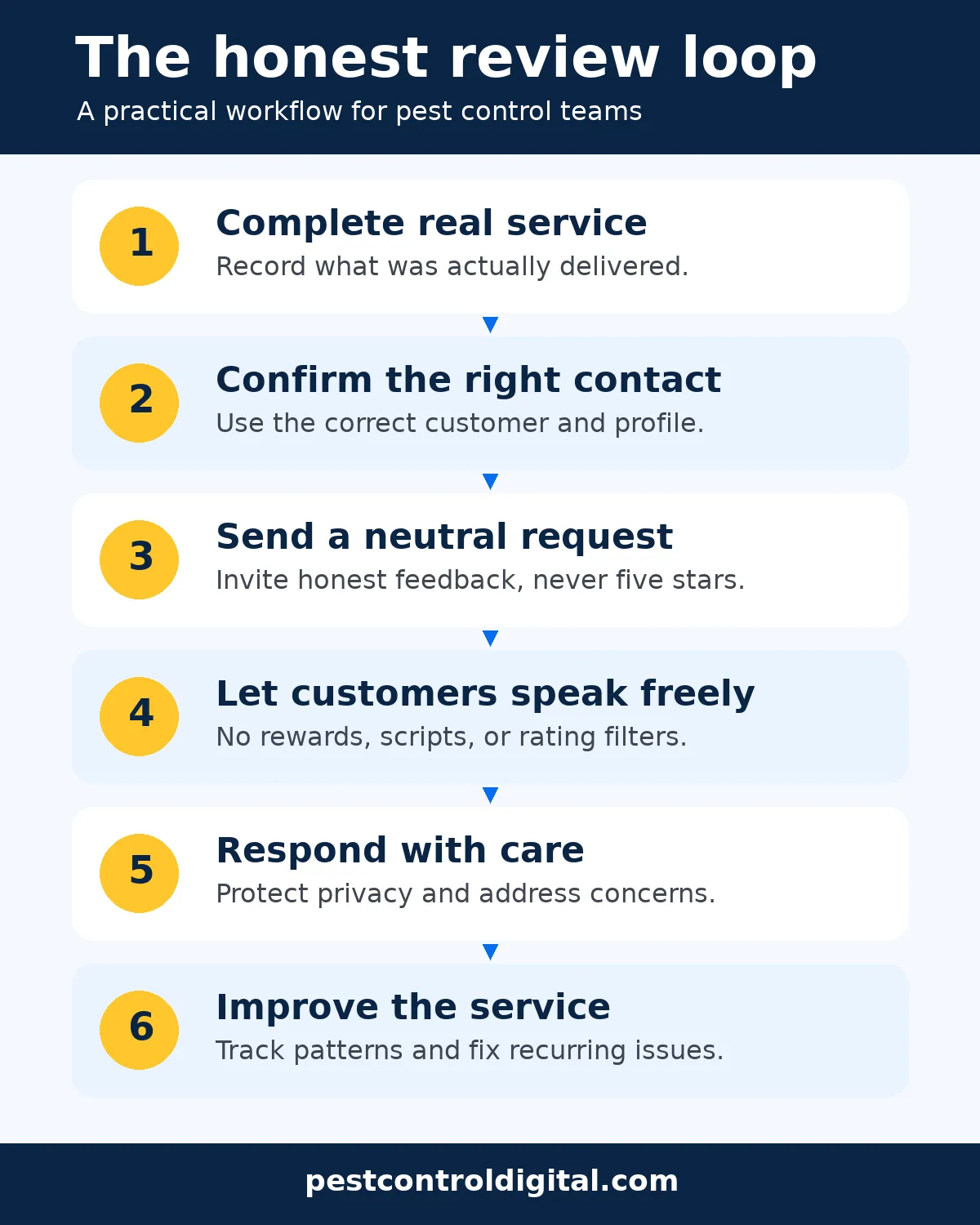
A short internal checklist helps: confirm the visit, confirm the correct customer contact, confirm the right Business Profile, send one neutral request, and record the send event. A reminder can be considered if it is respectful and the customer has not opted out, but repeated messages can damage trust.
Review requests are one part of the broader pest control lead generation mix. They should not interrupt dispatch, emergency calls, or necessary customer care. Build the workflow around the team you actually have, not an imagined large call center.
Know the rules: no incentives, gating, or invented reviews
Google’s Maps contribution policy prohibits paid or rewarded reviews, incentives for changing or removing a negative review, and selective requests aimed only at positive feedback. A discount offered for “any review” is still an incentive under Google’s platform policy, even if the rating is not specified.
The FTC’s Consumer Reviews and Testimonials Rule also addresses fake reviews, sentiment-conditioned incentives, certain undisclosed insider reviews, and review suppression. Its legal scope is not identical to Google’s platform policy. A practice might be legally permissible in some circumstances and still violate Google’s stricter rules.
| Practice | Assessment | Safer alternative |
|---|---|---|
| Send every real customer a neutral link | Permitted when genuine and voluntary | Use a consistent completed-service trigger |
| Give a gift card for any Google review | Prohibited by Google | Offer no reward for posting |
| Send links only after a positive survey | Prohibited selective solicitation | Invite all eligible customers equally |
| Ask staff or relatives to post as customers | Conflict-of-interest risk | Seek authentic independent experiences |
| Threaten a reviewer to remove criticism | Serious policy and legal risk | Investigate and respond respectfully |
Never buy review packages, use fake accounts, or ask staff to write testimonials pretending to be customers. If a reputation vendor promises a guaranteed number of five-star ratings, investigate its methods before allowing it to access your business profile.
Respond to positive and negative reviews without oversharing
A useful response to positive feedback thanks the customer and acknowledges a general service theme, such as clear communication or punctual arrival. Keep it brief and natural. Avoid repeating a sales pitch, keyword-stuffed city names, or the same scripted paragraph under every review.
Negative reviews deserve a calm, factual response. You can say you take the concern seriously and invite the person to contact your service manager. Do not disclose their address, treatment products, infestation details, account balance, or other private information in a public reply.
For example, if a homeowner says mice returned after an inspection, explain that the team can review the documented scope and follow-up plan. Do not publicly argue that the home is dirty or insist that one visit permanently eliminated every entry point. Good pest control reputation marketing reflects real service accountability.
Google allows businesses to flag reviews that violate its policies, but an unfavorable opinion alone is not a violation. Do not promise customers that you can delete legitimate criticism. Review replies should demonstrate how your company handles problems, not merely defend the star average.
Measure the review loop without chasing a star target
Track the process using real service records: completed eligible visits, review invitations sent, messages delivered where measurable, and new reviews observed on the correct profile. These counts help you find operational gaps. They do not prove that any particular request caused a review, and a review should never be tied to a promised ranking gain.
Separate service feedback from marketing attribution. A lower rating may reveal missed arrival windows, unclear preparation instructions, or poor follow-up. Feed those patterns into operations. Compare the issues with call recordings and booking records only when customer consent and applicable privacy rules allow it.
For multiple crews, examine whether some completed visits never trigger a request. Correct the workflow rather than ranking technicians by star counts. For multiple locations, keep each location’s review link tied to its legitimate profile; citation management also helps maintain consistent public business details.
Review counts are not a conversion metric by themselves. Use landing-page and call tracking to understand how inquiries become inspections, and keep review monitoring as a separate customer-experience report. This prevents an attractive dashboard from hiding unresolved service problems.
How Pest Control Digital helps
We help pest control owners audit the customer review journey, check profile accuracy, and connect service follow-up with a practical local search strategy. Our pest control reputation marketing service focuses on legitimate requests, helpful responses, and measurable workflows, not guaranteed ratings.
For businesses reviewing their wider online presence, our Google Maps SEO service can assess profile completeness and local visibility alongside reviews. Start with the actual problems in your dispatch and customer communication process before paying for new software.
Frequently asked questions about pest control reviews
Can a pest control company ask every customer for a Google review?
Yes. Ask real customers who experienced your service, regardless of whether they seemed pleased or disappointed. Use the same neutral invitation and process for eligible completed visits. Never filter people through a satisfaction survey before giving them the Google review link.
When should we request a review after termite or rodent work?
Ask after the customer has experienced a meaningful completed service, such as an inspection or agreed visit, rather than promising the entire pest problem is permanently solved. For multi-visit jobs, explain what was completed. Keep any complaint or follow-up channel available independently of the review invitation.
Can we give a discount or gift card for a Google review?
No. Google’s Maps policy prohibits incentives for posting, changing, or removing reviews, even when the requested rating is not specified. The FTC also prohibits incentives conditioned on a particular review sentiment. Avoid contests, employee bonuses tied to review counts, and other pressure tactics.
Should we respond to a negative pest control review?
Usually, yes. Acknowledge the concern, avoid confirming a customer’s address or treatment details, and offer a private way to investigate the service record. Do not argue about pests, blame the reviewer, or demand that they change the rating. Report a review only when it violates platform policy.
Do more Google reviews guarantee higher Maps rankings?
No. Google says review volume and positive ratings can contribute to local prominence, alongside relevance and distance. Reviews are not a substitute for accurate service information, a legitimate Business Profile, or good service. No agency can guarantee a ranking position or number of calls.
What if customers say they cannot leave a review?
Confirm that the review link opens the correct verified Business Profile and that the customer is signed into a Google Account. Google permits accounts created with non-Gmail addresses. Do not ask customers to share passwords, use a staff device to submit a review, or create reviews on their behalf.
Want a more trustworthy local presence?
Get a practical review of your pest control website, Business Profile, and customer inquiry journey.